Our Pick: MayBee
Check price →The Best Beehive Frames and Foundation (2026)
Frames are the only part of a hive the bees actually live on, and the only part you will keep buying for as long as you keep bees. We ranked six frame and foundation picks from $15.19 to $93.99, and laid out the decisions that matter more than the brand: deep or medium, wax-coated plastic or pure wax or none at all, and when old black comb should retire.
By The BeehiveKits Hive Desk · 14 min read · 2026-08-28

MayBee Deep Frames with Wax Foundation (10-Pack)
MayBee
The restock-forever frame: sound deep frames with foundation included at about $3.12 each.
Check price★ Our Top Pick
Best Overall
MayBee Deep Frames with Wax Foundation (10-Pack)
The restock-forever frame: sound deep frames with foundation included at about $3.12 each.
Not sure yet? Compare all 6 picks below ↓
Our pick is the MayBee deep frames with wax foundation, 10-pack, at $31.19: assembled-style wooden frames, foundation included, at almost exactly three dollars a frame, which is the price-quality point where stocking a brood box stops hurting. Buying frames is not like buying a hive; it is like buying printer paper for a very demanding printer. Every colony you run wants 10 to 30 of them, wax moths and comb rotation retire a batch every year, and every spring flow demands more than you think you have. The winning strategy is a good frame at a repeatable price, bought before you need it.
The decisions that matter come before the brand. First, size: deep frames (9-1/8 inch, listed) for brood boxes, medium frames for honey supers in most modern backyard setups, and the strong case for standardizing before you own forty of the wrong one. Second, foundation: wax-coated plastic for durability and extractor-proof spinning, pure beeswax for the traditionalists, foundationless for the naturalists willing to manage crooked comb. Third, rotation: comb darkens and accumulates pesticide residues and pathogens with years of use, and the standard husbandry guidance, echoed across extension programs like the extension Bee Health program, is to retire brood comb on a three-to-five-year cycle. Frames are consumables; plan like it.
It is all built on one Victorian insight. Langstroth's 1852 movable-frame patent turned on the discovery of bee space, the roughly 3/8 inch gap bees leave open instead of gluing shut, which is why frames hang at precise spacing and slide out for inspection at all, a story told properly on the Langstroth hive entry. Every pick below is a standard Langstroth-dimension frame that respects that geometry; what separates them is joinery, foundation quality, and price per frame.
The disclosure, as always: no brand paid for placement and none saw this guide before publication. Links go to Amazon; purchases may earn us a small commission at no cost to you, and it never moves a ranking. Prices are the verified listings at publication, check the live page. And if you are still choosing the boxes these frames go in, start with our guides to the best 10-frame beehives and best beehive starter kits, then come back to fill them.
The short version
- Our pick is the MayBee deep frames with wax foundation 10-pack ($31.19): sound wooden frames, foundation included, about $3.12 a frame.
- Buying in bulk wins: the MayBee 20-pack ($56.99) drops the per-frame price and covers a second brood box or the spring rush.
- Standardize your frame size early: deeps for brood, mediums for honey supers is the common modern split, and mixed sizes multiply every future purchase.
- Wax-coated foundation gets drawn faster; heavier wax coating (or brushing on your own cappings wax) is the cheapest acceptance upgrade there is.
- Foundation-only sheets like the BEEINN 8-1/2 inch pack ($15.19) rehabilitate old frames for a fraction of the cost of new ones.
- Rotate brood comb out on a 3-to-5-year cycle per extension husbandry guidance: dark, old comb carries residues and pathogens, and frames are cheap insurance.
| Pick | Best for | Contents | Per frame | Price |
|---|---|---|---|---|
| MayBee Deep Frames 10-Pack | Our Pick | 10 deep frames + wax foundation (listed) | ~$3.12 | $31.19 |
| Honey Lake Deep Frames 10-Pack | Best Value Alternative | 10 deep frames + foundations (listed) | ~$3.29 | $32.92 |
| BeeCastle Frames 10-Pack | Best Kit-Matching 10-Pack | 10 deep frames + wax foundations (listed) | ~$3.89 | $38.94 |
| MayBee Frames 20-Pack | Best Bulk Buy | 20 frames, beeswax-coated (listed) | ~$2.85 | $56.99 |
| BeeQuestify 20-Pack | Best Premium Bulk | 20 deep 9-1/8 in frames + coated foundation (listed) | ~$4.70 | $93.99 |
| BEEINN Foundation Sheets | Best Foundation-Only | 8-1/2 in deep wax-coated sheets (listed) | n/a | $15.19 |
The 2026 frame and foundation shortlist. Dimensions and pack contents are the manufacturers' listed figures; prices verified against the live listings on 2026-08-28.
01 · Best Overall
Our PickMayBee Deep Frames with Wax Foundation (10-Pack)
The restock-forever frame: sound deep frames with foundation included at about $3.12 each.
Field check: 10 deep brood frames with wax foundation (listed) · ~$3.12 per frame
The best frame is the one you can buy again without thinking. Frames disappear into the apiary at a rate that surprises every new keeper: ten to a brood box, another ten when the colony needs a second deep, replacements for the batch the wax moths found in the shed, and the annual retirement of the oldest, blackest comb. The MayBee deep frame 10-pack is our pick because it makes that recurring purchase boring in the best way: standard Langstroth deep dimensions (listed), foundation included so the pack is hive-ready, and a per-frame price near three dollars that holds up against buying components separately.
Fit note: these are deep frames for deep brood boxes; confirm your boxes before ordering, because a deep frame in a medium box is a geometry lesson nobody enjoys. They pair naturally with the MayBee and Honey Lake deep boxes most of our starter-kit readers already run, and when the foundation eventually earns retirement on the three-to-five-year rotation covered below, the frames themselves soldier on with fresh sheets from the BEEINN pack at the bottom of this guide.
- Contents
- 10 frames with wax foundation (listed)
- Size
- Deep (brood box) (listed)
- Material
- Wood frames, wax foundation (listed)
- Per frame
- ~$3.12
- Compatibility
- Standard Langstroth deep boxes
- Price
- $31.19
What we like
- Hive-ready: foundation included in the pack
- Lugs take a hive tool without complaint
- About $3.12 a frame, repeatable every season
- Matches the budget deep boxes most beginners run
Worth noting
- 10-packs run out fast; bulk buyers pay less per frame below
- Expect to true the occasional sheet on arrival
- Deep only: super stockers need mediums elsewhere
Who should buy it: Buy the MayBee 10-pack as your standard brood-frame restock: first hive owners filling a second deep, and anyone who wants one reliable answer to the frames question they can reorder every spring without re-researching.
What we don't like: It is a 10-pack in a hobby that consumes frames in twenties; heavy users should step to the bulk packs below for the better per-frame price. As with all budget frames, inspect the pack on arrival for the odd warped bar or wavy sheet, and seat foundation snugly before the bees start building on it.
Bottom line: This is the default answer to the most repeated purchase in beekeeping: a 10-pack of deep frames with wax foundation already in them, from the same MayBee stable as our favorite budget hive boxes, at $31.19. The frames take a hive tool without shedding lugs, the foundation arrives flat, and the price is low enough to buy the spare set that every apiary eventually thanks itself for.
02 · Best Value Alternative

Honey Lake Deep Frames and Foundations Kit (10-Pack)
The other excellent $3-and-change frame: Honey Lake's deep 10-pack with foundations included.
Field check: 10 deep frames with foundations (listed) · ~$3.29 per frame
Two brands, one commodity, and that is good news. The budget frame market has converged on a healthy standard: wooden deep frames, foundation included, three dollars and change each, and the Honey Lake deep frames kit executes it as well as our top pick does. Joinery is sound, the foundations arrive usable, and the dimensions are the listed Langstroth standards that make frames interchangeable across every box in a backyard apiary, which is precisely the point of the system.
Our top-pick edge for MayBee comes down to a slightly better per-frame price at the current verified listings, $3.12 versus $3.29, and nothing more profound. Keep both slugs bookmarked; in the March-to-May frame shortage, the one that ships this week is the best frame in America. And either way, run the same arrival ritual: check lugs, true any wavy sheets, and get frames into boxes before the flow, because the cost of arriving short is measured in unharvested pounds.
- Contents
- 10 deep frames with foundations (listed)
- Size
- Deep (brood box) (listed)
- Material
- Wood frames with foundation (listed)
- Per frame
- ~$3.29
- Compatibility
- Standard Langstroth deep boxes
- Price
- $32.92
What we like
- Effectively interchangeable with our top pick
- Keeps Honey Lake apiaries brand-consistent
- Standard listed Langstroth dimensions
- The in-stock answer during spring shortages
Worth noting
- Seventeen cents more per frame than the MayBee
- Same arrival-inspection ritual as all budget packs
- Deep only
Who should buy it: Buy the Honey Lake 10-pack if your equipment is already Honey Lake, or as the fully interchangeable backup when the MayBee listing runs dry. Same job, same tier, seventeen cents more per frame.
What we don't like: Slightly pricier per frame than our pick at the verified listings, with no offsetting advantage we can name. The usual budget-pack caveats apply: inspect on arrival, seat foundations snugly, expect an occasional imperfect bar.
Bottom line: Functionally the twin of our top pick from the other big budget-beekeeping brand: ten deep frames with foundations, standard Langstroth dimensions as listed, $32.92. If your hives are Honey Lake boxes, or the MayBee listing is out of stock in the spring rush, this is the same decision with a different label, and choosing between them on a given day is mostly a price-and-availability call.
03 · Best Kit-Matching 10-Pack
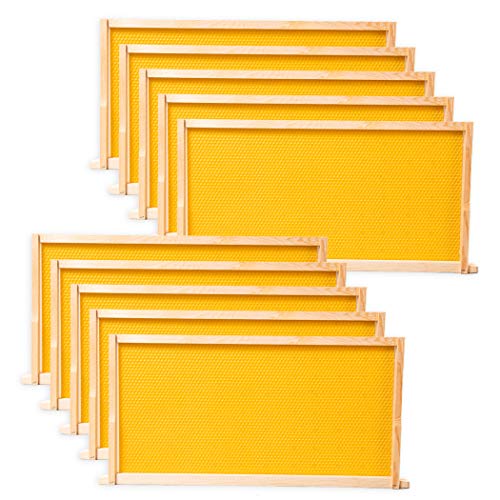
BeeCastle Frames and Wax Foundations (10-Pack)
The restock for BeeCastle hives: ten deep frames with wax foundations at $3.89 each.
Field check: 10 deep frames with wax foundations (listed) · ~$3.89 per frame
A consistent apiary is a small daily pleasure. If your boxes came from the BeeCastle lineup, whose beeswax-coated kits we rate highly, the BeeCastle frame 10-pack is the like-for-like restock: same maker's dimensional habits, wax foundations in the pack, frames that drop into their boxes with the fit you would hope for. The build holds the line the budget twins set, sound lugs, workable foundation, standard listed sizing, and adds nothing scandalous and nothing revolutionary.
Where BeeCastle's pack quietly shines is the fallback role: three interchangeable 10-packs across three brands means the spring frame shortage essentially cannot strand you, and seasoned keepers keep all three slugs in the back pocket for exactly that week. Whichever pack fills the boxes, the frames enter the same lifecycle: drawn in year one, cycled outward through the broodnest, and retired with the oldest comb on the extension-endorsed three-to-five-year rotation this guide's final break lays out.
- Contents
- 10 deep frames with wax foundations (listed)
- Size
- Deep (brood box) (listed)
- Material
- Wood frames, wax foundations (listed)
- Per frame
- ~$3.89
- Compatibility
- Standard Langstroth deep boxes
- Price
- $38.94
What we like
- Like-for-like restock for BeeCastle hives
- Wax foundations included
- Interchangeable with every box in this guide
- Valuable third source in spring shortages
Worth noting
- Priciest of the three near-identical 10-packs
- No listed advantage for the premium
- Deep only
Who should buy it: Buy the BeeCastle 10-pack if your apiary runs BeeCastle equipment and you value the matched set, or as the third-string availability play when both cheaper twins are out of stock in the spring rush.
What we don't like: The per-frame premium buys consistency, not quality: nothing on the listed spec sheet justifies 20-plus percent over the MayBee. If price is the criterion, this is the third pick of three near-identical 10-packs.
Bottom line: BeeCastle's frame 10-pack completes the set for the many keepers running BeeCastle beeswax-coated hives: ten deep frames with wax foundations, listed to standard dimensions, at $38.94. It is a solid frame that costs a real premium over the twins above, so it earns its slot on ecosystem-matching and availability rather than raw value.
04 · Best Bulk Buy

MayBee Beeswax-Coated Frames (20-Pack)
The spring-rush answer: twenty beeswax-coated frames at about $2.85 each.
Field check: 20 beeswax-coated food-grade frames (listed) · ~$2.85 per frame
Nobody ever needed exactly ten frames. The real consumption events come in bigger bites: a booming colony wants its second deep (ten frames), a spring split wants a full box (ten more), rotation retires the three blackest combs per hive per year, and wax moths audit whatever you stored carelessly. The MayBee 20-pack of beeswax-coated frames prices for that reality: $56.99 for twenty, undercutting every 10-pack above on a per-frame basis and cutting the how-many-do-I-need arithmetic in half.
Storage is the one discipline bulk buying demands: spare frames with foundation keep beautifully stacked flat in a sealed tote, away from mice and moths, and miserably anywhere else. Buy the 20-pack ahead of spring, stage it properly, and you become the club member with frames to spare in May, which is a genuinely enviable social position. For apiaries at three-plus hives, this pack plus an annual reorder is the entire frame strategy, feeding the supers your yield math says the flow will fill.
- Contents
- 20 frames, beeswax-coated (listed)
- Coating
- Beeswax, food-grade (listed)
- Material
- Wood frames (listed)
- Per frame
- ~$2.85
- Compatibility
- Standard Langstroth boxes (confirm listed size)
- Price
- $56.99
What we like
- Best per-frame price of the assembled picks
- Beeswax coating speeds acceptance and drawing
- One order covers a box plus real spares
- Ends the mid-season frame emergency cycle
Worth noting
- Demands sealed, moth-proof storage
- Bulk multiplies the occasional imperfect unit
- Verify size against your boxes before committing
Who should buy it: Buy the 20-pack once you run two or more hives, plan any splits, or are tired of mid-season frame emergencies: it is the best per-frame price in the guide and the right unit for how frames actually get consumed.
What we don't like: Twenty frames need proper storage, sealed, dry, moth-proof, or the savings feed the wax moths. Confirm the listed size matches your boxes before ordering in bulk, and expect the same occasional-imperfection rate as any budget pack, now across twenty units.
Bottom line: The bulk pack that matches how apiaries actually consume frames: twenty at once, beeswax-coated and food-grade as listed, at about $2.85 per frame, the best per-frame price of any assembled pick in this guide. One order fills a second brood box and banks the spares that swarm season, splits, and comb rotation will inevitably claim.
05 · Best Premium Bulk
Upgrade Pick
BeeQuestify 9-1/8 Inch Frames with Coated Foundation (20-Pack)
The buy-nicer bulk pack: twenty 9-1/8 inch deep frames with beeswax-coated foundation, ready to work.
Field check: 20 deep frames, 9-1/8 in, beeswax-coated foundation (listed) · ~$4.70 per frame
Premium in frames means boring, in the best way. The budget packs above are good value with a known tax: the occasional warped bar, the sheet that needs truing, the light coating that wants help. The BeeQuestify 20-pack is priced to remove the tax: listed 9-1/8 inch deep frames, the standard brood dimension, with beeswax-coated foundation throughout, aimed at arriving uniform enough that the whole pack goes straight from box to hive on a Saturday morning. For keepers whose time is the scarce input, twenty frames that need zero fettling is a real product.
The 9-1/8 inch listing deserves a nod: that is the correct full-depth Langstroth deep, the dimension the whole movable-frame system standardized on after Langstroth's 1852 patent, and stating it plainly is the kind of spec confidence we wish every frame listing had. Run these as your brood-chamber backbone, restock the cheaper twins for rough duty and rotation fodder, and every box in the apiary still interchanges, which is the entire genius of the standard.
- Contents
- 20 deep frames with coated foundation (listed)
- Size
- 9-1/8 inch deep (listed)
- Coating
- Beeswax-coated foundation (listed)
- Material
- Wood frames (listed)
- Per frame
- ~$4.70
- Price
- $93.99
What we like
- Full 9-1/8 inch deep standard, plainly listed
- Coated foundation in all twenty frames
- Consistency aimed at zero-fettling deployment
- The right unit for apiary launches and splits
Worth noting
- Highest per-frame price in the guide
- No colony-level advantage over cheaper twins
- Overkill for casual top-ups
Who should buy it: Buy the BeeQuestify 20-pack when you are standing up a new apiary, running multiple spring splits, or simply value frames that arrive uniformly ready over saving $1.85 each: the premium bulk play for time-poor keepers.
What we don't like: At ~$4.70 a frame it is the most expensive way to buy frames in this guide, and the bees draw comb on it exactly as happily as on the budget twins. The premium buys your time and consistency, not colony outcomes; budget-first keepers should take the MayBee 20-pack and the inspection ritual.
Bottom line: The BeeQuestify 20-pack is the premium version of the bulk strategy: twenty full deep frames at the listed 9-1/8 inch standard with beeswax-coated foundation in every one, at $93.99. The per-frame price is the highest in the guide, and what it buys is consistency, a pack where every frame arrives straight, coated, and ready, which some keepers will happily pay $1.85 a frame extra to get.
06 · Best Foundation-Only

BEEINN Wax-Coated Deep Foundation Sheets (8-1/2 Inch)
New comb, old frames: wax-coated 8-1/2 inch deep foundation sheets for $15.19.
Field check: 8-1/2 inch deep wax-coated foundation sheets (listed) · fits standard deep frames
Comb wears out; frames mostly do not. The rotation guidance this guide keeps citing, retire brood comb every three to five years as it darkens and accumulates residues and pathogens, per husbandry guidance echoed by the extension Bee Health program, sounds expensive until you notice that only the comb needs retiring. The wooden frame around it is usually fine for another decade. The BEEINN foundation sheet pack completes that arithmetic: cut out the old comb, scrape the frame clean, seat a fresh wax-coated sheet, and the rebuilt frame costs a fraction of a new one.
Fresh foundation also pays forward: rotation works best as a conveyor, new frames enter at the broodnest edge, old comb migrates outward over seasons, and the blackest frames exit annually, so a cheap steady supply of sheets is what keeps the conveyor turning. Brush on a little extra melted cappings wax from your harvest's uncapping tray and acceptance improves further, at a cost of zero. For the keeper managing comb age across several hives, this $15.19 pack is the highest-leverage line item on the page.
- Contents
- Deep foundation sheets, wax-coated (listed)
- Size
- 8-1/2 inch deep (fits 9-1/8 in deep frames) (listed)
- Coating
- Beeswax-coated (listed)
- Use
- New builds and comb-rotation rehabs
- Price
- $15.19
What we like
- Makes the 3-to-5-year rotation genuinely cheap
- Rehabs sound old frames for pennies each
- Wax-coated for faster acceptance
- Highest leverage per dollar in the guide
Worth noting
- Labor included: comb-out and re-sheeting is real work
- Fragile in cold; store flat and gentle
- Deep size only in this pack
Who should buy it: Buy the BEEINN sheets once you own frames worth rehabilitating: every apiary running the 3-to-5-year comb rotation, thrifty keepers rebuilding rather than rebuying, and anyone whose shed holds sound frames with tired comb.
What we don't like: Foundation-only means labor: cutting out old comb, cleaning grooves, and seating sheets is honest winter work, not a shortcut. Sheets are also fragile in cold weather and want gentle, flat storage. Confirm your frames are grooved to accept sheets before ordering.
Bottom line: The thriftiest purchase in this guide: foundation sheets alone, listed at the 8-1/2 inch depth that fits standard deep frames, wax-coated, for $15.19. Wooden frames outlive their comb by a decade, and this pack is how the three-to-five-year rotation gets cheap: pop out the old black comb, snap in a fresh sheet, and a retired frame goes back to work.
More gear worth comparing
Beyond this guide: the highest-rated gear across every category and budget, with a live price check on each.



As an Amazon Associate we may earn from qualifying purchases, at no cost to you.
Quick shop: every pick
Skip the scroll: the whole lineup, with a live price check on each.
- MayBee Deep Frames with Wax Foundation (10-Pack)Best OverallMayBee · $31.19Check price →
- Honey Lake Deep Frames and Foundations Kit (10-Pack)Best Value AlternativeHoney Lake · $32.92Check price →
- BeeCastle Frames and Wax Foundations (10-Pack)Best Kit-Matching 10-PackBeeCastle · $38.94Check price →
- MayBee Beeswax-Coated Frames (20-Pack)Best Bulk BuyMayBee · $56.99Check price →
- BeeQuestify 9-1/8 Inch Frames with Coated Foundation (20-Pack)Best Premium BulkBeeQuestify · $93.99Check price →
- BEEINN Wax-Coated Deep Foundation Sheets (8-1/2 Inch)Best Foundation-OnlyBEEINN · $15.19Check price →
How we chose
We judge frames the way bees and hive tools do: joint strength at the top-bar lugs (where a propolized frame gets pried loose), foundation flatness (wavy foundation means wavy comb forever), and whether the listed dimensions actually respect Langstroth spacing.
Per-frame price is the ranking currency, because frames are consumables bought again and again; a great frame at an unrepeatable price loses to a good frame you can restock every spring.
Foundation acceptance matters: bees draw wax-coated foundation faster and more evenly than bare plastic, so coating quality (as listed, and as delivered) is scored on every pick.
Would we put a colony on it: no questionable coatings, no soft-wood lugs that snap under a hive tool, no dimensions that violate bee space and get bridged with burr comb.
Specs, dimensions, and pack contents are the manufacturers' listed figures, hedged as listed; we do not repeat a measurement we have not verified.
No brand pays for placement, and prices come from the verified offer table on the publication date; listings that vanish or spike lose their slot on update.
Key terms
- Deep frame
- The 9-1/8 inch frame used in deep brood boxes, the standard canvas for the queen's brood nest. A full deep box of honey weighs 80-90 pounds by the standard estimates, which is why deeps rarely serve as honey supers.
- Medium frame
- The shorter frame for medium supers, the common modern choice for honey storage because a full medium box weighs around 50 pounds, a liftable number. Some keepers standardize on mediums for the whole hive.
- Foundation
- The embossed starter sheet, wax-coated plastic or pure beeswax, that guides bees to build straight, centered comb inside the frame. Coated foundation is accepted faster than bare plastic.
- Foundationless
- Running frames with only a starter strip so bees build natural comb at their own cell sizes. Natural and cheap, but demands early correction of crooked comb and gentle extraction.
- Bee space
- The roughly 3/8 inch gap bees leave open rather than filling with comb or propolis, the 1852 Langstroth insight that makes removable frames possible. Frame and box dimensions exist to preserve it.
- Lug
- The protruding ear at each end of a frame's top bar that hangs on the box's rabbet. The frame's structural weak point and the place quality differences show up under a hive tool.
- Burr comb
- Comb built outside the frames, in any gap that violates bee space. A little is normal; a lot means a spacing or equipment problem.
- Comb rotation
- Retiring the oldest brood comb on a 3-to-5-year cycle, per extension husbandry guidance, because old comb accumulates pesticide residues and pathogens. Frames get rebuilt with fresh foundation and return to service.
Questions, answered
What size frames do I need for my beehive?
Match the box: deep boxes take deep frames (9-1/8 inch), medium supers take medium frames, and 8-frame versus 10-frame width only changes how many you buy, not the frame size. The common modern setup is deeps for the brood chamber and mediums for honey supers. Check your box depth before ordering; every assembled pick in this guide is a deep.
How many frames does a beehive need?
Ten per 10-frame box (eight per 8-frame box), and a typical hive runs one or two deep brood boxes plus two or three medium supers in season, so a single mature hive can employ 30 to 50 frames. Add spares for splits and the annual comb rotation, and per-hive frame ownership of 40-plus is normal, which is why the bulk packs and per-frame prices matter.
Is plastic or wax foundation better?
For most backyard keepers, wax-coated plastic wins on durability: it survives fast extractor spins, resists wax moths in storage, and rehabs forever by scraping and re-waxing, while bees accept it readily once the coating is decent. Pure wax foundation is accepted fastest and is all-natural, but it sags in heat and blows out in extractors. The pragmatic answer the market has settled on is plastic, coated heavily.
What is foundationless beekeeping and should beginners try it?
Foundationless frames give bees only a starter strip and let them build natural comb at their own cell sizes. It is cheap and appealingly natural, but new colonies routinely build crooked or cross-comb that must be caught and corrected within weeks, and unsupported natural comb needs wiring or very gentle extraction. We suggest beginners start on coated foundation, then experiment with a few foundationless frames once comb-reading feels routine.
How often should you replace beehive frames and comb?
The standard extension husbandry guidance is to rotate brood comb out every three to five years, in practice, retiring the few oldest, darkest frames per hive each spring, because old comb accumulates pesticide residues and disease spores as generations of brood cycle through it. The wooden frames themselves usually last a decade or more: cut out the old comb, clean the frame, and fit a fresh foundation sheet.
Why is old brood comb black, and is it a problem?
Comb darkens naturally as each brood generation leaves cocoons and debris behind; black comb is old comb, not diseased comb per se. The concerns are cumulative: cells shrink slightly, and the wax absorbs fat-soluble pesticide residues and can harbor pathogens, which is exactly why the 3-to-5-year rotation exists. If comb smells foul or shows disease signs, that is a different and urgent problem; get a diagnosis, not just a rotation.
Why won't my bees draw comb on new foundation?
Usually one of three reasons: no nectar flow (bees barely make wax without incoming nectar or feeding), a thin wax coating on plastic foundation (brush on melted cappings wax to fix it), or the frames sitting outside the cluster where no bees are working. Add new frames at the edge of the broodnest during a flow or while feeding, on well-waxed foundation, and drawing usually starts within days.
Can I mix frame brands in the same hive?
Yes. Any maker's frames built to standard Langstroth dimensions interchange freely, that interchangeability is the entire point of the standard, and the MayBee, Honey Lake, BeeCastle, and BeeQuestify picks in this guide all coexist in one box happily. What you should not mix is sizes: a deep frame cannot go in a medium box, and gaps left by wrong-size frames get filled with burr comb fast.
How should I store spare frames and foundation?
New frames with fresh foundation store easily: flat, dry, sealed against mice, cool enough that wax does not sag. Drawn comb is the treasure that needs guarding, wax moths destroy unprotected stored comb, so store drawn frames in sealed totes, freeze them first if they have been on a hive, and check them monthly. Foundation sheets alone store flat and gentle, and get brittle in cold, so handle winter-stored sheets carefully.
Filed under Buyer's Guide
Part of Hive Kits
Keep reading
The Best 10-Frame Beehives
The boxes these frames go in: the full-size Langstroth hives we would put a colony in.
8-Frame vs 10-Frame Beehives
The width decision that sets how many frames every future purchase needs, settled honestly.
The Best Honey Extractors (2026)
Where these frames end up every August: the spinners that empty them and hand the drawn comb back.
The Best Honey Harvesting Equipment (2026)
The uncapping and bottling line, including the cappings wax that upgrades your next foundation batch.
How Much Honey Does One Hive Produce?
The yield math that tells you how many supers, and therefore frames, the flow will demand.
The Best Beehive Starter Kits
For readers still assembling hive one: complete kits, frames included, ranked by whether we would put a colony in them.