Our Pick: VEVOR
Check price →How Much Honey Does One Hive Produce?
The honest answer is a range, not a number: an established, healthy colony in most US regions yields about 30 to 60 pounds of surplus honey in a normal year, a first-year colony usually yields close to none, and the gap between a 20-pound year and an 80-pound year comes down to forage, weather, colony strength, and mites. Here is the whole calculation, jars included.
By The BeehiveKits Hive Desk · 14 min read · 2026-08-28

VEVOR 2/4 Frame Manual Honey Extractor
VEVOR
The right-sized spinner for the 30-to-60-pound reality: 2 deep or 4 shallow frames per load, $110.42.
Check price★ Our Top Pick
The First-Harvest Extractor
VEVOR 2/4 Frame Manual Honey Extractor
The right-sized spinner for the 30-to-60-pound reality: 2 deep or 4 shallow frames per load, $110.42.
Not sure yet? Compare all 2 picks below ↓
Every new beekeeper runs this math at the kitchen table: jars of honey times farmers-market prices, multiplied by daydream. So let us replace the daydream with the real numbers. A strong, established colony in most of the United States produces roughly 30 to 60 pounds of surplus honey in an average season, which is one to two full medium supers, or roughly 30 to 60 one-pound jars. Exceptional colonies in exceptional forage push past 100 pounds; weak colonies, bad-weather years, and heavy mite loads produce nothing harvestable at all. And your first year? Plan on zero, and be pleasantly surprised if you get a few frames.
The word doing the work in every one of those sentences is surplus. A colony makes far more honey than you will ever harvest, and it makes it for itself: honey is the colony's winter heating fuel, and the bees' target stores come first. What you harvest is only what exceeds their needs, which is why the same hive can yield 60 pounds in a clover-rich Midwest summer and nothing the year a drought shuts the nectar off in July. Understanding yield means understanding the whole pipeline: what the bees can gather, what they must keep, and what that leaves for you.
This explainer walks the entire calculation: realistic ranges by region, why first-year colonies rarely produce, the four levers that actually move yield, the jar math for a super, when to harvest, and, most important of all, how much to leave so the colony is alive to do it again next spring. We cite extension guidance where the numbers deserve it, and we keep the equipment talk to the two tools a first harvest genuinely requires: a basic extractor and a refractometer, both covered in full in our guides to the best honey extractors and best honey harvesting equipment.
The short version
- Established, healthy colonies in most US regions yield about 30 to 60 pounds of surplus honey per year; great years and great forage can double that.
- First-year colonies usually produce little or no harvestable surplus: they are spending the season building comb and winter stores.
- One 10-frame medium super holds roughly 30 to 40 pounds of extractable honey, call it 30 to 40 one-pound jars.
- The four yield levers, in order: forage within two miles, weather during the nectar flow, colony strength going into that flow, and varroa mite load.
- Harvest only capped, ripe honey (below roughly 18.6% moisture on a refractometer) and only after the colony's winter stores are covered.
- Winter store targets scale with climate: colonies in cold-winter regions need substantially heavier stores than Gulf-state colonies, and the bees get paid first.
01 · The First-Harvest Extractor
VEVOR 2/4 Frame Manual Honey Extractor
The right-sized spinner for the 30-to-60-pound reality: 2 deep or 4 shallow frames per load, $110.42.
Field check: 2 deep / 4 shallow frames per load (listed) · stainless steel drum (listed) · hand crank
Match the machine to the math. If your apiary fits the ranges in this article, one to four colonies, one to two medium supers each, you will be extracting somewhere between 20 and 200 frames a season, and the VEVOR 2/4 frame manual extractor covers that comfortably: a 10-frame medium super clears in three loads. The stainless drum passes the food-grade bar, the crank means no outlet required, and the price leaves budget for the refractometer below.
The quiet reason an extractor beats crush-and-strain is a yield reason, not a convenience one: spinning returns empty drawn comb to the hive, and a colony that reuses comb skips weeks of wax-building next spring, wax that costs the bees several pounds of honey per pound of wax to produce. Protecting your comb bank is one of the cheapest ways to raise next season's number, which is exactly the logic of the levers section below. For bigger apiaries or electric options, the full rankings are in our honey extractor guide.
- Frames per load
- 2 deep or 4 medium/shallow (listed)
- Drive
- Geared hand crank
- Drum material
- Stainless steel (listed)
- Honey gate
- Bottom gate (listed)
- Price
- $110.42
What we like
- Sized exactly for 1-4 hive yields
- Preserves drawn comb, next year's head start
- Stainless drum, no outlet needed
- Leaves budget for the refractometer
Worth noting
- Hand crank caps solo throughput
- Flip-per-load tangential routine
Who should buy it: Buy this when your second-season colonies are heading into a real flow with supers on: it is the right first extractor for 1 to 4 hives and the yields this article projects for them.
What we don't like: You are the motor, and solo you cannot crank and uncap simultaneously; past four hives the electric version of this same drum ($209.90) is the better buy. Tangential baskets mean flipping each load partway through.
Bottom line: Once the yield math in this explainer says you have a super or two of surplus coming, this is the machine we recommend to extract it: an honest 2-deep/4-shallow stainless drum with a hand crank, sized exactly for the one-to-four-hive harvests these numbers describe. It preserves your drawn comb, which is next year's yield lever, and costs $110.42.
02 · The Ripeness Check
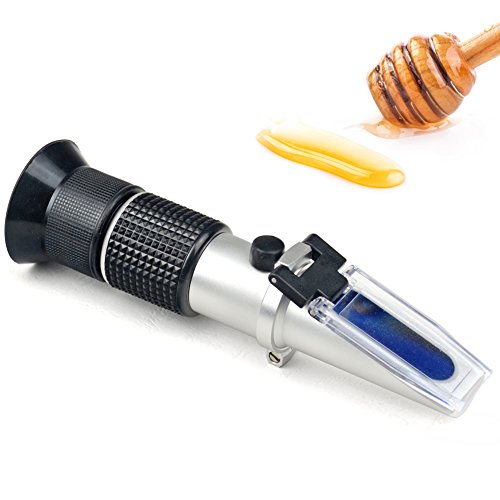
aichose Honey Refractometer
The $22.88 instrument that turns "is it ready?" into a ten-second measurement.
Field check: Optical refractometer · honey moisture, Brix, Baume scales (listed) · $22.88
Capping is the bees' opinion; the refractometer is the fact. Bees generally cap honey once they have dried it to ripeness, which makes mostly-capped frames the classic harvest signal, but humidity, part-capped frames, and early pulls all blur that rule. The aichose honey refractometer removes the ambiguity: a smear on the prism, a glance at the light, and you know whether the crop is below the roughly 18.6% moisture line where honey resists fermentation, guidance summarized by the extension Bee Health program.
For the yield math in this article it matters twice. It lets you harvest confidently at the margins, that half-capped super in a humid August, instead of leaving good honey or bottling wet honey. And it guards stored crop: a 5-gallon bucket holding 60 pounds, a whole hive's season, ferments just as happily as a jar if it went in wet. Calibrate it once at the start of harvest week and it is honest all season; the digital alternative and the rest of the harvest line live in our harvesting equipment guide.
- Type
- Optical refractometer
- Scales
- Honey moisture, Brix, Baume (listed)
- Key threshold
- Ripe below ~18.6% moisture
- Power
- None (optical)
- Price
- $22.88
What we like
- Settles harvest timing in ten seconds
- Protects bucket-stored crop too
- No batteries to die mid-harvest
- Costs less than two jars of good honey
Worth noting
- One-time calibration required
- Eyepiece scale, not a digital readout
Who should buy it: Buy it before your first harvest, whatever your yield: anyone bottling honey needs the moisture answer, and this is the cheapest reliable instrument that gives it.
What we don't like: Needs a one-time calibration, decent light, and room-temperature samples; the readout is an eyepiece scale rather than a screen. Nothing that matters at $22.88.
Bottom line: Every harvest-timing question in this article ends at the same instrument: honey is ripe and safe to bottle below roughly 18.6% moisture, and the aichose reads a drop of honey against that line in ten seconds. At $22.88 it is the cheapest insurance in beekeeping, protecting an entire season's crop from fermenting in the jar.
The short answer: 30 to 60 pounds, eventually
A healthy, established colony, meaning one that survived at least one winter, with a laying queen, drawn comb, and a managed mite load, produces roughly 30 to 60 pounds of surplus honey per season across most of the United States. That is the number the mainstream beekeeping literature converges on, the number experienced club members will give you, and the number our own harvests keep landing inside. In jar terms: 30 to 60 one-pound jars, or one to two full medium supers per hive.
The distribution around that average is wide and lumpy. A booming colony parked next to clover pasture in a wet-spring year can clear 100 pounds; the same genetics in a drought year, or under a heavy varroa load, can produce nothing you should take. And the average conceals the most important single fact in this article: the first-year number is usually zero, for reasons that are structural, not a sign you did anything wrong. The rest of this guide unpacks each piece.
Typical yields by region, honestly hedged
Regional averages are directional, not destiny: your two-mile forage radius matters more than your time zone. With that hedge stated plainly, reported backyard yields cluster roughly like this:
| Region | Typical surplus, established hive | What drives it |
|---|---|---|
| Midwest / Plains | ~50-80+ lbs | Clover, alfalfa, long summer flows; the classic honey country |
| Northeast | ~30-60 lbs | Strong spring flow (black locust, basswood), summer dearth varies |
| Southeast | ~30-50 lbs | Early, fast spring flows; hot summer dearth; long season helps colonies, not always crops |
| Mountain West | ~30-60 lbs | Irrigated valleys and wildflower years swing results widely |
| Pacific Northwest | ~30-60 lbs | Blackberry flow is the season-maker west of the Cascades |
| Southwest / arid | ~20-40 lbs | Rain-dependent desert blooms; irrigation and monsoon timing decide the year |
Two honest footnotes. First, these are backyard figures: commercial operations chasing flows by truck routinely report higher per-hive averages. Second, annual colony losses in recent US surveys have run around 40 to 50 percent, per the Bee Informed Partnership loss surveys, and a dead colony's yield is zero: across an apiary and a few years, survival management adds more honey than any forage map. Your local beekeeping club's old-timers know your county's real number; ask them.
Why your first year is usually a zero
A package or nuc installed in April is not a honey factory; it is a construction site. Before a colony can store surplus, it must draw comb, and wax is expensive: bees consume several pounds of honey to secrete a single pound of wax, and a new colony has to build the equivalent of its entire pantry, nursery, and warehouse from bare foundation. Most of the first season's nectar becomes infrastructure and brood, not crop.
The colony also starts small and peaks late. Honey gets made when a big field force meets a big nectar flow, and a first-year colony typically reaches full strength after the main flow has passed. Add the winter-stores bill, which the bees pay before you see a drop, and the arithmetic lands where extension programs like Penn State's Beekeeping 101 set beginner expectations: little to no surplus in year one, with the real payoff arriving in year two, when the colony wakes up strong, on drawn comb, and catches the spring flow from day one. If your first-year colony gives you a few frames of harvestable honey, celebrate; if it gives you none but goes into winter heavy, you did it right.
The jar math: what a super actually holds
Yield talk becomes real at the extractor gate, so here is the container arithmetic. Figures are working estimates, full boxes vary with how well frames are drawn and capped:
| Box | Full weight (listed estimates) | Extractable honey | ~1-lb jars |
|---|---|---|---|
| 10-frame deep (as a super) | ~80-90 lbs | ~55-70 lbs | 55-70 |
| 10-frame medium super | ~50 lbs | ~30-40 lbs | 30-40 |
| 8-frame medium super | ~40 lbs | ~25-30 lbs | 25-30 |
Per frame, a well-filled medium gives roughly 3 to 4 pounds of honey and a deep roughly 6 to 8, which is why almost nobody uses deeps as honey supers: a full one is a back-injury delivery system, one of several reasons our box-size comparison keeps steering hobbyists toward mediums. So when this article says an established hive yields 30 to 60 pounds, read it as one to two medium supers, or 30 to 60 one-pound jars, or about 2.5 to 5 gallons in the bucket. The Langstroth hive literature covers the box standards themselves if you want the dimensional rabbit hole.
Yield lever 1: forage within two miles
Bees routinely work a two-mile radius (and can push farther), which means your yield is set less by your backyard than by the roughly 8,000 acres around it. The best backyard apiaries sit near abundance they do not own: clover and alfalfa fields, suburban tree bloom (maples, black locust, basswood), unmowed roadsides, community gardens, water. The worst sit in manicured turf deserts or monocrop country where everything blooms, and ends, in the same two weeks.
You cannot move 8,000 acres, but you can read them. Walk your radius in each season and note what blooms when; the gaps you find are your dearths, and they explain your hive-scale readings better than any calendar. Planting for bees helps at the margins (a quarter-acre of wildflowers is lovely and roughly a rounding error), while siting decisions, even moving hives a mile to a better radius, move whole supers. Forage is also the lever behind regional tables: the Midwest's numbers are big because its radii are full of legumes, not because its beekeepers are better.
Yield lever 2: weather during the flow
Nectar flow is a weather event wearing a flower costume. The plants in your radius set the ceiling, but the year's rain and temperature decide what fraction of that ceiling gets paid out. The classic good year: a wet fall and winter charge the soil, a warm early spring builds colonies, and mild, occasionally rainy weather through the bloom keeps nectar secretion going for weeks. The classic heartbreaker: a perfect bloom that a week of cold rain keeps the bees from flying in, or a drought that shuts secretion down with the supers half full.
You control none of this, which is exactly why it belongs in your expectations. The same apiary, same management, swings 2x year to year on weather alone, so judge your beekeeping on multi-year averages, not single seasons. The practical hedges: keep supers on ahead of the flow (bees cannot store what they have no room for), and in dearth-prone regions, be ready to feed after harvest so the colony rebuilds its own stores in a nectar-empty fall; our feeder guide covers that toolkit.
Yield lever 3: colony strength at the flow
Here is the least intuitive rule in honey production: one strong colony out-produces two mediocre ones. Honey surplus scales nonlinearly with population, because a colony's overhead, brood rearing, thermoregulation, feeding itself, is roughly fixed, and every bee beyond the overhead threshold is nearly pure field force. A 60,000-bee colony does not make twice the surplus of a 30,000-bee colony; it can make three or four times as much.
This converts yield-chasing into spring management. The colonies that hit the main flow at full strength are the ones that came out of winter healthy, got room before they needed it (so they did not swarm; a prime swarm walks off with half your field force two weeks before the flow), and had a good queen laying hard in March and April. It is also the argument for the second-year advantage: overwintered colonies on drawn comb start the spring build-up six weeks ahead of any package. The management rhythm that produces flow-ready colonies is the whole subject of our first-year calendar and the reason we harp on spring inspections everywhere on this site.
Yield lever 4: mites, the silent yield tax
Varroa mites take their cut before you take yours. A rising mite load through summer weakens exactly the bees that would have made your crop, the late-summer generations, shortens their lives, and vectors the viruses that turn a booming July colony into an October deadout. Extension guidance converges on a treatment threshold around 2 to 3 mites per 100 bees by alcohol wash or sugar roll, per programs like the extension Bee Health program, and colonies held below it simply produce more: stronger field forces this year, and a hive that is alive to produce next year.
The yield connection is blunt when you recall the survey numbers: with US annual colony losses running around 40 to 50 percent in recent Bee Informed Partnership surveys, and varroa the leading manageable cause, mite control is worth more pounds of honey, averaged over an apiary and a few seasons, than any other decision in this article. Monitor monthly in season, treat when the wash says treat, and mind the label windows (some treatments cannot run with honey supers on; formic products carry a listed temperature window). The full toolkit lives in our varroa treatment guide.
When to harvest: ripeness, not the calendar
Harvest timing is two tests, not a date. Test one, the bees' signal: a frame is ready when it is mostly capped, the bees seal cells once they have dried the honey to ripeness. The old field rule takes frames that are three-quarters capped or better. Test two, the instrument: a reading below roughly 18.6% moisture on a tool like the aichose honey refractometer, the threshold below which honey resists fermentation. The instrument settles every case the eyeball rule fumbles: humid climates, part-capped frames, early pulls.
In most of the US this lands in mid to late summer, after the main flow ends and before fall management begins, with a practical note attached: harvest on a warm day (honey spins out far faster warm than cool), clear the bees with an escape board or brush rather than heroics, and get frames from hive to extractor promptly. Everything downstream, uncapping, spinning, straining, settling, verifying, bottling, is a solved workflow, and our harvesting equipment guide walks it station by station.
Leave enough for winter: the bees get paid first
The most expensive honey you will ever harvest is the ten pounds the colony needed in February. Winter stores are the colony's fuel, and the targets scale with winter length, working figures in line with extension guidance, always cross-checked against your local club's numbers:
| Winter climate | Target honey stores going into winter | Rough config |
|---|---|---|
| Cold / long (Upper Midwest, Northeast, mountains) | ~80-90 lbs | Deep plus a full medium, heavy |
| Moderate (Mid-Atlantic, lower Midwest, PNW) | ~50-60 lbs | Deep plus a well-filled medium |
| Mild / short (Gulf states, low-elevation South, coastal CA) | ~30-40 lbs | A heavy deep, monitored |
The field check is the heft test: lift the back of the hive in early fall, and it should feel almost immovably heavy; scale-minded keepers weigh, everyone else learns the feel fast. If stores are light after harvest, feed heavy syrup in early fall until the weight is right, and keep checking through winter, colonies starve in late winter, inches from honey, more often than in December. Harvest math done in the right order is simply: total honey minus winter target equals your crop, and some years that subtraction says the crop is zero. Wrapping, wind protection, and the rest of cold-season prep live in our winterizing guide.
A worked example: the three-hive backyard, year two
Put every piece together for a realistic mid-Atlantic apiary: three colonies, second season, on drawn comb, mites managed. Colony A wintered strong, caught the whole locust-and-clover flow, and filled two mediums: ~70 lbs. Colony B swarmed in May, requeened itself, and filled most of one medium: ~30 lbs. Colony C superseded early, stayed small, and needs every frame it stored: 0 lbs harvested, and it gets fall feeding besides.
Apiary total: roughly 100 pounds, about 33 per hive, squarely inside the 30-to-60 band even though no single colony landed on the average. That variance is normal and permanent: yield is a portfolio statistic, which is one of the quiet arguments for running two or three hives instead of one (the other being that a strong hive can donate brood to rescue a weak one). One hundred pounds is also five gallons in the bucket, about 100 one-pound jars, and far more honey than most households consume in a year, which is the moment most beekeepers discover the farmers-market table. The startup-to-payoff economics of all this are itemized in our cost index.
How to raise next year's number
Ranked by pounds-per-effort, the moves that actually work: (1) Keep colonies alive. Averaged over years, mite management is the biggest yield program there is; a deadout yields zero forever. (2) Protect drawn comb. Extract instead of crushing, store supers safe from wax moths, and return wet frames to the hives; comb is prepaid infrastructure. (3) Manage swarming. Space ahead of need and a spring split done on your terms beats losing half a field force to a swarm two weeks before the flow. (4) Super early. Bees cannot store what they have no room for; supers go on before the flow, not during it. (5) Requeen the laggards. A colony that underperforms two seasons running has a genetics problem you can fix for the price of a queen.
Note what is missing: gadgets. Yield responds to biology and timing, not accessories, and the equipment that matters, sound boxes, good frames, a working extractor, mostly matters by not failing. The one planting-adjacent move with real leverage is siting: if a better two-mile radius exists within reach, an out-yard there is worth more than anything you can order online.
Sizing your equipment to your real yield
Work the numbers backward into the shopping list. At the 30-to-60-pound reality, a one-to-three-hive apiary extracts 30 to 180 pounds a season, which the $110 VEVOR 2/4 frame manual extractor handles in an afternoon or two; the electric upgrade earns its $100 premium at about three-plus hives, and the 8-frame machines are for ten-hive ambitions, math we run fully in the extractor guide. The rest of the harvest line is cheap and mandatory: heated knife, fork, strainer, gated bucket, refractometer, about $150 well spent, itemized in the harvesting equipment guide.
Storage math: figure one 5-gallon bucket (~60 lbs) per strong hive as the ceiling, and buy jars in the humbling quantities the arithmetic implies, a 100-pound year is roughly eight cases of one-pound jars. On the hive side, each colony wants two to three medium supers available in a good flow, with frames ready; running short of drawn frames mid-flow is a classic self-inflicted yield cap, and our frames and foundation guide covers stocking up without junk.
Year two and beyond: what the trajectory looks like
The typical arc, assuming colonies survive and mites are managed: Year one, zero to a few frames, colony builds comb and stores. Year two, the breakout, an overwintered colony on drawn comb catches the full flow, and 40-to-60-pound harvests are common. Year three onward, the portfolio era: yields per hive settle into your area's honest range, variance spreads across colonies, and your average is made in spring management and mite control. Many keepers also split their strongest colonies each spring, trading some honey for apiary growth, which is the other dividend a strong colony pays.
Calibrate the daydream one last time: at 30 to 60 pounds per established hive, two or three backyard colonies produce more honey than a family uses, enough for gifts that make you briefly famous, and a modest market table. What they do not produce is meaningful income against honest accounting, and the beekeepers who last are the ones who wanted the bees first and the honey second. If that is you, start with the how-to-start guide, buy boxes worth putting a colony in from the starter-kit rankings, and let year two surprise you properly.
How to estimate and take your honey harvest
- 1
Count your ripe supers
In mid-to-late summer, after the main flow, inspect each hive top-down. Count frames that are roughly three-quarters capped or better; a well-filled 10-frame medium of them holds about 30 to 40 pounds of extractable honey.
- 2
Subtract the colony's winter share first
Check the brood chamber's stores against your climate target (roughly 80-90 lbs of stores for cold winters, 50-60 moderate, 30-40 mild) and the heft test. Only frames beyond that target are crop; some years the answer is none.
- 3
Verify ripeness with a refractometer
Sample a few frames, including any part-capped ones. Below roughly 18.6% moisture is ripe and safe to bottle; higher readings mean leave the frames on the hive, or dry the extracted honey in a dehumidified room before bottling.
- 4
Pull frames and clear the bees
Harvest on a warm day using an escape board, bee brush, or gentle shaking, and move frames into a covered container immediately; open honey in the apiary starts a robbing frenzy in minutes.
- 5
Uncap, spin, strain, settle
Run the line in order: heated knife and fork to uncap, extractor to spin, mesh strainer into a food-grade bucket, then 24 to 48 hours of settling so bubbles and wax fines rise. Return the wet, empty frames to the hives for cleanup and reuse.
- 6
Re-check, bottle, and feed if needed
Confirm the settled honey's moisture once more, bottle through a honey gate, and label. Then re-check hive weights: if harvest left any colony light, start feeding heavy syrup in early fall until winter targets are met.
More gear worth comparing
Beyond this guide: the highest-rated gear across every category and budget, with a live price check on each.




As an Amazon Associate we may earn from qualifying purchases, at no cost to you.
Quick shop: every pick
Skip the scroll: the whole lineup, with a live price check on each.
- VEVOR 2/4 Frame Manual Honey ExtractorThe First-Harvest ExtractorVEVOR · $110.42Check price →
- aichose Honey RefractometerThe Ripeness Checkaichose · $22.88Check price →
Key terms
- Surplus honey
- Honey beyond what the colony needs for its own survival, the only honey a beekeeper should harvest. An established hive's surplus in most US regions runs about 30 to 60 pounds a year.
- Nectar flow
- A period when major forage plants secrete nectar heavily and colonies gain weight fast. The main flow (often spring to early summer) is when nearly all surplus honey is made.
- Dearth
- A stretch with little or no nectar available, commonly mid-to-late summer. Colonies consume stores during dearth, which is why harvests are measured after it, not before.
- Drawn comb
- Comb already built out on frames. It is the colony's prepaid infrastructure: overwintered colonies on drawn comb catch the spring flow weeks ahead of new colonies building from foundation, the core of the second-year yield jump.
- Capped honey
- Honey the bees have dried to ripeness and sealed under wax cappings. Mostly-capped frames are the traditional signal that honey is ready to harvest.
- Refractometer
- The instrument that measures honey moisture from a single drop. Honey below roughly 18.6% moisture resists fermentation and is safe to bottle and store.
- Varroa threshold
- The mite load, around 2 to 3 mites per 100 bees by wash or roll in extension guidance, at which treatment is warranted. Colonies kept below it live longer and yield more.
- Heft test
- Judging a hive's stores by lifting its back edge. A winter-ready hive feels almost immovably heavy; a light one needs fall feeding before cold sets in.
Questions, answered
How much honey does one beehive produce per year?
An established, healthy colony in most US regions produces roughly 30 to 60 pounds of surplus honey per season, about one to two medium supers, or 30 to 60 one-pound jars. Exceptional colonies in rich forage can exceed 100 pounds, and poor years or weak colonies can yield nothing harvestable. First-year colonies usually produce little or no surplus.
How much honey do you get the first year of beekeeping?
Usually none, and that is normal. A new colony spends its first season drawing comb (which costs several pounds of honey per pound of wax), raising its population, and storing its own winter fuel, and it typically reaches full strength after the main flow has passed. Extension beginner guidance sets the same expectation. The payoff is year two, when an overwintered colony on drawn comb commonly yields 40 to 60 pounds.
How many jars of honey is one super?
A well-filled 10-frame medium super holds roughly 30 to 40 pounds of extractable honey, which is about 30 to 40 one-pound jars. An 8-frame medium runs about 25 to 30 jars, and a full deep used as a super holds 55 to 70 pounds, one reason deeps are rarely used for honey: a full one weighs 80 to 90 pounds.
What affects how much honey a hive produces?
Four levers, in rough order: forage quality within the colony's two-mile flight radius; weather during the nectar flow (rain and temperature decide whether plants secrete); colony strength at the start of the flow (one strong colony out-produces two mediocre ones); and varroa mite load, which quietly taxes the field force and, unmanaged, kills colonies outright.
How much honey should I leave for my bees in winter?
Scale it to your winter: roughly 80 to 90 pounds of stores for cold, long winters (Upper Midwest, Northeast), 50 to 60 for moderate climates, and 30 to 40 for mild southern winters, cross-checked with local club guidance. The bees get paid first: only honey beyond that target is harvestable, and light colonies should be fed heavy syrup in early fall.
When should I harvest honey?
When two tests agree: frames are mostly capped (roughly three-quarters or better), and a refractometer reads below about 18.6% moisture, the ripeness line beneath which honey resists fermenting. For most of the US that means mid to late summer, after the main flow. Harvest on a warm day and always settle the winter-stores question before taking frames.
Can you harvest honey twice a year?
In regions with two distinct flows, yes: many keepers pull a spring harvest (often lighter, delicate varietals) and a summer one. In single-flow regions most people harvest once, after the main flow. Each extra harvest adds handling and robbing risk, so the practical rule is: harvest when ripe supers accumulate, and never take the fall flow in cold-winter areas, the bees need it.
Is one strong hive better than two weak ones for honey?
For yield, emphatically yes: surplus scales nonlinearly with population because colony overhead is roughly fixed, so a double-strength colony can make three or four times the surplus. But running two or three hives is still smart apiary design, yields average out across colonies, and a strong hive can donate brood to rescue a struggling one.
How much is a hive's honey worth?
At typical US farmers-market prices for local honey, a 30-to-60-pound harvest is worth a few hundred dollars retail, real money for a hobby, rarely income after honest accounting for equipment, treatments, and time. Our beekeeping cost index runs the full ledger. Most backyard keepers land on the same answer: the honey subsidizes the hobby, and the bees are the point.
Filed under Explainer
Part of Beekeeping 101 · Honey Harvest
Keep reading
The Best Honey Extractors (2026)
When the math in this article says a harvest is coming: nine spinners ranked by hive count, from $108 manuals to the 8-frame VIVO.
The Best Honey Harvesting Equipment (2026)
The rest of the line in workflow order: uncapping knives, strainers, settling gear, gated buckets, and the refractometer.
First-Year Beekeeping Calendar
The season-by-season rhythm that turns a package into the strong second-year colony that actually makes honey.
The Best Varroa Mite Treatments
The biggest yield program in beekeeping is keeping colonies alive: monitoring, thresholds, and the treatment toolkit.
The Best Beehive Frames and Foundation
Stocking the supers your flow will need: deep vs medium, foundation types, and the comb-rotation schedule.
How to Start Beekeeping
The cornerstone walkthrough for readers still at the daydream stage of the jar math.