Our Pick: NOD Apiary
Check price →The Best Varroa Mite Treatments (2026)
Varroa mites are the number one reason colonies die, and hoping is not a treatment plan. We ranked the six legal treatments we would actually put in a hive, from the supers-on benchmark Formic Pro to the new RNAi option, organized by chemistry class so you can rotate like the pros, plus a sidebar on small hive beetles while you have the lid off.
By The BeehiveKits Hive Desk · ~16 min read · 2026-08-28

Formic Pro Varroa Mite Treatment, 2-Dose
NOD Apiary
The supers-on formic acid benchmark: reaches mites under cappings, sized right for a backyard apiary.
Check price★ Our Top Pick
Best Overall
Formic Pro Varroa Mite Treatment, 2-Dose
The supers-on formic acid benchmark: reaches mites under cappings, sized right for a backyard apiary.
Not sure yet? Compare all 7 picks below ↓
Our pick is Formic Pro in the 2-dose pack (about $30): the formic acid treatment you can run with honey supers on, that reaches mites under the brood cappings where most of them hide, and that leaves no meaningful residue in wax. For a beekeeper with one or two hives and a mite count over threshold, it is the treatment we reach for first, and the 10-dose pack (about $78) is the same answer for a bigger yard. But varroa control is not a one-product story, and anyone who treats with the same chemistry forever is breeding the mites that beat it. This guide covers all five legal chemistry classes so you can build a rotation, not just a purchase.
The stakes are not abstract. Varroa destructor is an external parasitic mite that feeds on honey bees and transmits viruses like deformed wing virus, and it is widely considered the single largest driver of colony losses; the biology is well documented on the Varroa destructor entry and in university extension programs. US beekeepers have reported annual colony losses around 40 to 50 percent in recent national surveys tracked by the Bee Informed Partnership, and untreated varroa is the most common thread running through those dead-outs. A colony that looks strong in August and is dead by December almost always tells a varroa story.
One rule sits above every product in this guide: monitor first, then treat, and always follow the product label. A mite wash takes ten minutes and tells you whether you need to spend a dollar at all, and the label on each treatment is a legal document that specifies dose, timing, temperature, and whether honey supers can stay on. We will tell you what each treatment is for and when it shines; the label tells you exactly how to apply it, and nothing on this page replaces it.
The disclosure, plainly: no manufacturer paid for a placement in this guide, and none saw it before publication. Some links go to Amazon; if you buy through one we may earn a small commission at no extra cost to you, and that never moves a pick. Prices are approximate at publication, always check the live listing, and check that a treatment is registered for use in your state before you buy.
The short version
- Our pick is Formic Pro 2-dose (about $30): formic acid works with supers on, penetrates brood cappings, and fits a 50 to 85F label window; the 10-dose pack (about $78) covers bigger apiaries.
- Monitor before you treat: an alcohol wash of about 300 bees is the standard, and extension guidance puts the common treatment threshold around 2 to 3 mites per 100 bees.
- Rotate chemistry classes year to year: formic, thymol (Apiguard), amitraz (Apivar), oxalic (VarroxSan), and now RNAi (Norroa) each hit mites differently, and rotation slows resistance.
- Apivar amitraz strips (about $30) are the set-and-forget brood-season option, but honey supers come off per the label.
- VarroxSan (about $42) brings extended-release oxalic acid to hives with brood, no vaporizer hardware required.
- Small hive beetles ride along with weak colonies: in-frame traps like the witbee Beetle Blaster 50-pack (about $30) are a cheap standing defense.
| Treatment | Chemistry | Supers on? | Best for | Approx. price |
|---|---|---|---|---|
| Formic Pro 2-Dose | Formic acid | Yes (per label) | Our Pick: 1 to 2 hives | ~$30 |
| Formic Pro 10-Dose | Formic acid | Yes (per label) | Best for multiple hives | ~$78 |
| VarroxSan Strips | Oxalic acid, extended release | Check current label | Oxalic with brood present | ~$42 |
| Apiguard 10 x 50g | Thymol | No (per label) | Best thymol option | ~$43 |
| Apivar 2.0, 4 strips | Amitraz | No (per label) | Set-and-forget brood season | ~$30 |
| Mann Lake Norroa | RNAi (listed) | Check current label | New rotation class | ~$40 |
| witbee Beetle Blaster 50-pack | Mechanical trap (beetles) | Yes | Small hive beetle defense | ~$30 |
The 2026 varroa treatment shortlist at a glance. Chemistry class and label conditions are the listed manufacturer claims; always follow the current product label. Prices are approximate at publication, verified against our offer table in August 2026.
01 · Best Overall
Our PickFormic Pro Varroa Mite Treatment, 2-Dose
The supers-on formic acid benchmark: reaches mites under cappings, sized right for a backyard apiary.
Field check: Formic acid polysaccharide strips · supers-on use per label · 50-85F label window (listed)
Most mites are not on your bees; they are under the cappings. At any moment during brood season, the majority of a colony's varroa are sealed inside capped brood cells, feeding on developing pupae where contact treatments cannot touch them. Formic acid is the chemistry with a long-standing reputation, noted in extension literature such as the bee health extension program, for penetrating those cappings, which is why Formic Pro 2-dose earns the top slot. The strips are formic acid suspended in a polysaccharide gel; you lay them across the top bars per the label, close the hive, and the acid does the work over the listed treatment period.
The other headline is honey. Formic acid occurs naturally in honey already, and Formic Pro's label allows treatment with honey supers on, which means an August mite spike does not force you to choose between the mite treatment and the honey crop. That single fact makes it the most flexible tool in the box: spring buildup, summer flow, fall cleanup, all fair game as long as temperatures cooperate. For a one-to-three-hive backyard, the 2-dose pack is the right buy; beekeepers running more colonies should skip straight to the Formic Pro 10-dose reviewed next. Either way, wash your bees first: the alcohol wash routine in our decision framework above tells you whether you need this at all.
- Chemistry class
- Formic acid (organic acid)
- Format
- Gel strips laid on top bars (listed)
- Honey supers
- May remain on per label
- Label temperature window
- About 50-85F daytime highs (listed)
- Doses in box
- 2 (listed)
- Approx. price
- ~$30
What we like
- Works with honey supers on, per the label
- The chemistry credited with reaching mites under cappings
- No meaningful wax residue: organic acid already present in honey
- Simple strip application a first-year beekeeper can do right
- Fits spring, summer flow, and early fall treatment slots
Worth noting
- Hard temperature ceiling: hot-climate summers can close the window
- Strong fumes; queen and brood stress if the label is ignored
- Only two doses per box
Who should buy it: Buy the 2-dose pack if you run one to three hives and your mite wash is at or over the treatment threshold during a season when supers are on. It is also the right first treatment for a beginner who wants one product that covers most of the calendar: the application is simple strip placement, and the label is clear about temperature.
What we don't like: The temperature ceiling is real: in a Gulf South or desert summer the label window can be hard to find, and applying it too hot risks brood and occasionally the queen. The fumes demand respect during application, and colonies often beard hard for a day or two afterward, which alarms new beekeepers. It is also a two-treatment box: bigger yards outgrow it immediately.
Bottom line: Formic Pro is the treatment we recommend first because it solves the two problems that trip up every other class: it works with honey supers on, and it is the one chemistry credited with reaching mites reproducing under the brood cappings. The 2-dose pack treats a small apiary without leftovers. Watch the temperature window on the label and it is the closest thing varroa control has to a default answer.
02 · Best for Multiple Hives

Formic Pro Varroa Mite Treatment, 10-Dose
Identical chemistry to our top pick, packaged for the sideliner: ten doses at a lower cost per hive.
Field check: Same formic acid strips as the 2-dose · 10 doses per pack (listed) · supers-on use per label
Varroa management scales with the yard, and the box should too. Once you are past three or four colonies, treating out of 2-dose packs gets expensive and annoying: partial boxes, staggered purchases, and the temptation to stretch product. The Formic Pro 10-dose pack fixes the economics: about $78 for ten doses versus about $30 for two, which is the difference between roughly eight dollars a dose and fifteen. For a five-to-ten-hive sideliner, that adds up to real money every season, and treating every colony in the yard on the same day with the same product is also just better mite management: no untreated hive sits next door reinfesting its treated neighbors.
Shelf life is the one planning note: check the dating on arrival and store the pack as the label directs, because a bargain box that expires before fall is no bargain. Otherwise the buying logic is simple. One or two hives, buy the 2-dose. Anything more, buy this, run your alcohol washes across the yard, and treat everything over threshold inside the same label window. Pair it with a different chemistry class the following season, Apiguard or VarroxSan below, and you are running the rotation the resistance researchers keep asking beekeepers to run.
- Chemistry class
- Formic acid (organic acid)
- Format
- Gel strips laid on top bars (listed)
- Honey supers
- May remain on per label
- Doses in box
- 10 (listed)
- Cost per dose
- Roughly $8 at publication
- Approx. price
- ~$78
What we like
- Best per-dose cost in the formic class
- Enough product to treat a whole yard in one window
- Same supers-on, capping-penetrating chemistry as our top pick
- Keeps rotation records simple: one class, one date, all hives
Worth noting
- Overkill for one or two hives
- Same hard temperature ceiling as the 2-dose
- Requires proper storage for unused doses per label
Who should buy it: Buy the 10-dose pack if you run four or more colonies, or if you and a beekeeping neighbor want to split a box and treat both yards in the same window. It is the standard fall-treatment purchase for sideliners who want formic's supers-on flexibility across a whole apiary without paying 2-dose prices.
What we don't like: All of the 2-dose caveats carry over: the temperature window, the fumes, the bearding. Ten doses is too many for a hobbyist with two hives, and product that sits for years is product you should not trust; buy the size you will use. Per the label, unused strips need proper storage, which not every garage provides in summer.
Bottom line: This is not a different product; it is the same Formic Pro strips in the quantity a growing apiary actually needs. At about $78 for ten doses the per-hive cost drops meaningfully below the 2-dose pack, and treating a whole yard in one session with one chemistry keeps your records and your rotation clean. Everything we said about the 2-dose, the supers-on flexibility, the capping penetration, the temperature discipline, applies unchanged.
03 · Best Oxalic With Brood
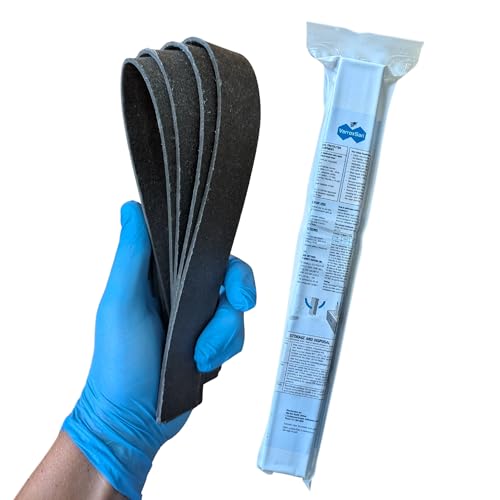
VarroxSan Oxalic Acid Strips
Extended-release oxalic acid strips: the slow-drip approach that works while brood keeps emerging.
Field check: Oxalic acid extended-release strips (listed) · multi-week hang time per label · no vaporizer hardware needed
Oxalic acid finally learned patience. Oxalic has long been the darling of winter treatment because it is cheap, effective, and gentle on bees, but only when the colony is broodless and every mite is exposed. During the other nine months, a one-shot oxalic application is a leaky net. VarroxSan strips take the slow road instead: cellulose strips loaded with oxalic acid hang between brood frames for an extended period per the label, so mites emerging with each new cycle of brood walk into the treatment day after day. It is the same logic as an amitraz strip, executed with an organic acid that does not accumulate in wax.
Application is refreshingly boring: hang the listed number of strips in the brood area per the label, close up, and come back on the label's schedule. There are no fumes to manage on application day and no batteries to charge. The trade-offs are the class's usual ones: efficacy builds gradually rather than crashing mite counts overnight, so this is a treatment you run on schedule ahead of trouble, not a rescue for a colony already collapsing under deformed wing virus. Verify current registration and super guidance for your state on the label, wash bees before and after per our monitoring framework, and rotate it against formic or thymol in alternating seasons.
- Chemistry class
- Oxalic acid (organic acid), extended release
- Format
- Cellulose strips hung between brood frames (listed)
- Treatment duration
- Multi-week, per label
- Hardware
- None required
- Approx. price
- ~$42
What we like
- Oxalic acid efficacy without vaporizer hardware
- Extended release covers emerging brood cycles
- No fume management on application day
- Organic acid: no meaningful wax accumulation
- Excellent rotation partner to formic and thymol
Worth noting
- Gradual action: not a rescue treatment
- Requires frame-by-frame placement in the brood nest
- Newer format: check current state registration and label guidance
Who should buy it: Buy VarroxSan if you want oxalic acid's clean chemistry without buying vaporizer hardware, or if your management calendar needs a treatment that works across weeks of brood emergence rather than a single knockout day. It is also a strong rotation partner for yards that leaned on formic or amitraz last season.
What we don't like: Slow-build efficacy means it is the wrong tool for a crisis-level infestation; a colony at ten mites per hundred bees needs a faster knockdown. The strips need correct placement in the brood nest, which means pulling frames, not just popping a lid. And because the format is newer, registration details and super guidance vary; read the current label for your state rather than assuming.
Bottom line: Classic oxalic acid has one famous weakness: it only kills the mites that are out in the open, so a single hit during brood season misses the majority sealed under cappings. VarroxSan answers that with extended release: strips hang in the brood nest for weeks per the label, catching mites as each round of brood emerges. It is the oxalic option for beekeepers who do not own a vaporizer and do not want to.
04 · Best Thymol Treatment

Apiguard Varroa Mite Treatment, 10 x 50g
The thymol standard: a warm-weather gel that adds a wholly different mode of action to your rotation.
Field check: Thymol slow-release gel · 10 x 50g trays (listed) · supers off per label
Rotation needs a second sword, and thymol is a good one. If formic is your workhorse, the worst thing you can do is make it your only horse. Apiguard attacks mites through a completely different mechanism: thymol vapor released from a slow-release gel, spread through the hive by the bees' own housecleaning behavior as they work to carry the gel out. That behavioral quirk is the design: the more the colony interacts with the tray, the better the distribution. You place a tray on the top bars per the label, typically with a spacer rim for headroom, and repeat per the label's schedule.
What we like most about Apiguard for backyard beekeepers is its forgiving nature: no acid fumes on application day, no strip-between-frames surgery, and a wide track record across decades and continents documented in the general varroa management literature at bee-health.extension.org. Colonies sometimes respond with a day of agitation and a distinctive thyme smell in the yard, both normal. Ten trays cover multiple hives through a full label course with spares for next season, making the roughly $43 box a two-year rotation asset for a two-hive yard. Wash bees after the course completes; if counts have not dropped, your next move is a different class, not a second helping.
- Chemistry class
- Thymol (botanical)
- Format
- Slow-release gel trays, 10 x 50g (listed)
- Honey supers
- Remove per label
- Temperature dependence
- Warm-weather treatment per label
- Approx. price
- ~$43
What we like
- Completely different mode of action for rotation
- Ten trays: multi-hive, multi-season value
- Simple tray placement, no acid handling
- Decades of field history behind the chemistry
Worth noting
- Supers off per label: post-harvest slot only
- Weeks-long course with temperature-dependent results
- Strong thyme odor during treatment
Who should buy it: Buy Apiguard if you are building a real rotation and need a non-acid, non-synthetic class for the post-harvest slot, or if formic's temperature window keeps missing your climate's fall. It suits beekeepers who prefer a tray-on-top application over frame-level work.
What we don't like: It is slow: a full course spans weeks per the label, and mid-course mite counts can test your nerve. Supers must come off, so it cannot rescue a colony during the flow. In cool climates the effective season is narrow, and the thyme smell, while harmless, is strong enough that your neighbors may comment.
Bottom line: Apiguard is thymol, the thyme-derived compound that has anchored one whole class of varroa control for decades. The gel trays release vapor the bees distribute as they try to remove it, and ten 50-gram trays make this box a full season of treatment for a small yard. It wants warm weather and patience, and it is precisely the kind of different-mode-of-action product a serious rotation needs.
05 · Best Set-and-Forget

Apivar 2.0 Amitraz Strips, 4 Strips
The amitraz workhorse: hang the strips, close the lid, and let weeks of contact exposure grind mites down.
Field check: Amitraz contact strips · multi-week hang per label · supers off per label
Sometimes the best treatment is the one you cannot screw up. Apivar 2.0 strips ask almost nothing of you: hang the labeled number of strips in the brood nest, positioned where the bees actually walk, and leave them for the label's full duration. Amitraz works by contact, bees touch the strip and distribute the active around the colony, and because the strips persist for weeks, every mite that emerges from capped brood during that span eventually meets the chemistry. That persistence is what formic's quick knockout cannot offer, and it is why Apivar is the default fall treatment across much of commercial beekeeping.
Practical notes: supers come off per the label, so Apivar naturally slots into the post-harvest fall window or early spring before supering. Mid-course, reposition strips per the label if the brood nest shifts away from them, since contact is the entire mechanism. And write the removal date somewhere you will see it: expired strips left in a hive are the classic path to sublethal exposure, which is exactly how resistance breeds. Used correctly, one label course per year, counts before and after, honest rotation, Apivar is a superb tool; used lazily it is tomorrow's fluvalinate.
- Chemistry class
- Amitraz (synthetic miticide)
- Format
- Contact strips hung in brood nest (listed)
- Treatment duration
- Multi-week hang per label
- Honey supers
- Remove per label
- Strips per pack
- 4 (listed)
- Approx. price
- ~$30
What we like
- Set-and-forget: one placement, weeks of coverage
- No temperature window anxiety
- Covers multiple brood emergence cycles
- The proven commercial fall standard
Worth noting
- Synthetic class with emerging resistance reports
- Supers off per label
- Strips must be removed on schedule, and people forget
Who should buy it: Buy Apivar if you want the lowest-effort effective treatment for the fall slot, if formic's temperature window does not fit your climate, or if you are treating while daytime temperatures swing too widely for organic acids. Four strips handle a standard two-brood-box setup per the label; check the label math for your configuration.
What we don't like: It is a synthetic in a class already showing resistance reports, so it must be rotated, not defaulted to. Supers off per the label takes it out of the honey-flow window. Strips must be physically placed and later removed on schedule, and the beekeepers who forget removal are actively breeding resistant mites for the rest of us.
Bottom line: Apivar is the treatment commercial beekeepers lean on for a reason: amitraz strips hang in the brood nest for an extended period per the label, killing mites by contact as bees brush past, through cycle after cycle of emerging brood. No temperature window to sweat, no fumes, no re-application visits. The costs are the class's: supers off per the label, and a real resistance risk if it becomes your only tool.
06 · Best New Technology
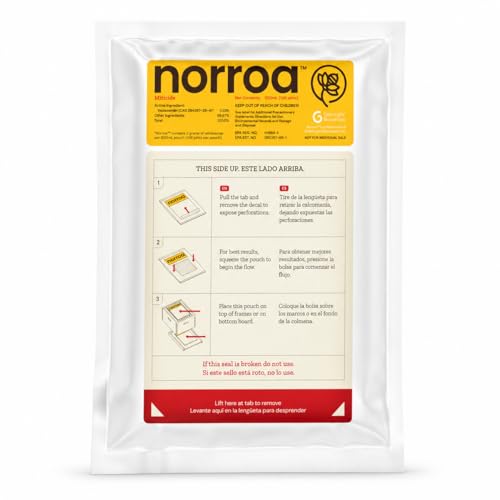
Norroa RNAi Varroa Mite Treatment
The first RNAi varroa treatment on the shelf: a listed 18 weeks of control from a genuinely new mode of action.
Field check: RNAi-based treatment (listed) · 18-week control claim (listed) · newest chemistry class available
A treatment that is not an acid, not a botanical, and not a synthetic miticide. RNA interference is a biological mechanism that silences specific genes, and applying it to varroa means targeting the mite itself rather than fumigating the whole hive, a research direction that has been building in the bee science community for years. Mann Lake's Norroa is that research arriving on the bee supply shelf, with a listed 18 weeks of control per treatment, a duration no organic acid can touch. Application details, timing, and super handling all come from the product label, which you should read start to finish before the box is open, because this class behaves like nothing else you have used.
Why include a newcomer in a best-of guide at all? Because the resistance math is unforgiving. Every legacy class in this guide is either already compromised somewhere (synthetics) or constrained by weather and supers (acids and thymol), and the national loss numbers tracked by the Bee Informed Partnership keep saying the existing toolbox is not winning. A genuinely new mode of action expands the rotation for everyone, and early adopters with good records are how the community learns fast. At about $40 it prices like an ordinary treatment, so the experiment costs little more than the fall treatment you were buying anyway. Follow the label, count mites before and after, and you are doing citizen science with a direct payoff.
- Chemistry class
- RNAi biological (listed)
- Control duration
- 18 weeks (listed)
- Format
- Per current product label
- Honey supers
- Per current product label
- Approx. price
- ~$40
What we like
- Genuinely new mode of action: expands the rotation
- Listed 18-week control outlasts every acid course
- Targets the mite biologically rather than fumigating the hive
- Ordinary treatment pricing for extraordinary novelty
Worth noting
- Short field track record so far
- Unfamiliar application: the label is mandatory reading
- Best validated on part of a yard before full adoption
Who should buy it: Buy Norroa if you are an experienced beekeeper who wants a new mode of action in the rotation and is willing to verify results with disciplined mite counts, or if resistance worries have you looking past the legacy classes. Beginners should run a proven acid or thymol course first and add this once monitoring habits are solid.
What we don't like: The field track record is short by definition, and a listed 18-week claim needs seasons of independent verification before anyone should bet a whole yard on it. Label familiarity is zero for most beekeepers, so application errors are likelier than with strips everyone knows. And as with any new class, price and availability may wobble while production scales.
Bottom line: Norroa is the most interesting thing to happen to varroa control in a generation: an RNAi-based treatment that targets the mite biologically rather than chemically, with a listed 18 weeks of control. It is new enough that the long-term field record is still being written, which is exactly why we position it as a rotation addition rather than a wholesale replacement. For beekeepers who want a fifth class in the toolbox, this is the door opening.
07 · Best Hive Beetle Defense

witbee Beetle Blaster Traps, 50-Pack
Fifty in-frame beetle traps for the price of one varroa treatment: the standing defense every southern yard needs.
Field check: In-frame oil traps · hang between top bars · 50 traps per pack (listed)
The beetles are already in your hive; the question is where they hide. Small hive beetles slip past guard bees and spend their days being chased into cracks and corners, where bees actually corral and guard them, a behavior described in the small hive beetle literature. In-frame traps exploit that exact dynamic: hang a witbee Beetle Blaster between two top bars, add a little food-grade oil, and the harassed beetles dive through the slots into the one hiding place they cannot climb back out of. The bees cannot enter, the oil is inert, and the trap sits flush enough that the inner cover closes normally.
The 50-pack is the right format because these are semi-disposable: a trap full of oil and dead beetles is easier to replace than to clean, and at roughly sixty cents each, replacement is the correct habit. Check and swap them during the same inspections where you run mite counts, and the whole pest program stays on one calendar. If you prefer a reusable style, the Zephiconn reusable beetle traps covered in the sidebar above trade a higher unit price for wash-and-refill service. Either way, a couple of traps per box from spring onward beats any reactive scramble in August.
- Type
- In-frame oil trap
- Placement
- Hangs between top bars (listed)
- Bait
- Food-grade oil (user supplied)
- Count
- 50 traps (listed)
- Approx. price
- ~$30
What we like
- Roughly sixty cents per trap at publication
- No chemicals in the hive: oil drowning only
- Fits standard frame spacing under the inner cover
- Season-long supply for a multi-hive yard
Worth noting
- Disposable by design
- Oil handling is mildly messy
- Cannot compensate for a weak, over-spaced colony
Who should buy it: Buy the 50-pack if you keep bees anywhere small hive beetles overwinter, which is most of the southern and coastal US, or if you have ever opened a weak colony to find beetles trotting across the comb. Fifty traps runs multiple hives for a full season with replacements to spare.
What we don't like: They are single-purpose plastic and effectively disposable, which grates if you hate consumables. Oil spills during placement are messy, and an overfilled trap can slosh onto bees. In heavy beetle country traps alone will not save a weak colony: they are one leg of a program built on colony strength.
Bottom line: Beetle Blasters are the disposable in-frame traps that hang between top bars: beetles fleeing bee harassment dive into the slots and drown in a splash of oil. No chemicals near the bees, no moving parts, and at fifty traps for about $30 you can run them in every hive all season and still have spares. For beekeepers in small hive beetle country, they are the cheapest insurance in the yard.
More gear worth comparing
Beyond this guide: the highest-rated gear across every category and budget, with a live price check on each.



As an Amazon Associate we may earn from qualifying purchases, at no cost to you.
Quick shop: every pick
Skip the scroll: the whole lineup, with a live price check on each.
- Formic Pro Varroa Mite Treatment, 2-DoseBest OverallNOD Apiary · ~$30Check price →
- Formic Pro Varroa Mite Treatment, 10-DoseBest for Multiple HivesFormic Pro · ~$78Check price →
- VarroxSan Oxalic Acid StripsBest Oxalic With BroodVita BeeHealth · ~$42Check price →
- Apiguard Varroa Mite Treatment, 10 x 50gBest Thymol TreatmentVita BeeHealth · ~$43Check price →
- Apivar 2.0 Amitraz Strips, 4 StripsBest Set-and-ForgetFoxhound Bee Co · ~$30Check price →
- Norroa RNAi Varroa Mite TreatmentBest New TechnologyMann Lake · ~$40Check price →
- witbee Beetle Blaster Traps, 50-PackBest Hive Beetle Defensewitbee · ~$30Check price →
How we chose
Legality and label first. Every varroa pick in this guide is a registered product with a real label; we do not cover homebrew acids, off-label tricks, or essential-oil folklore. The label defines dose, timing, temperature, and super handling, and our write-ups defer to it everywhere.
Chemistry coverage over brand loyalty. Resistance management is the long game in varroa control, so we deliberately shortlisted one strong option in each legal chemistry class rather than five versions of the same acid, following the integrated pest management approach laid out by the Honey Bee Health Coalition.
Bee safety through the colony lens. Would we put a colony in it: we weight queen safety, brood impact, and honey contamination risk as the manufacturers and extension literature describe them, and we flag every treatment's known rough edges honestly.
Beginner applicability. A treatment a first-year beekeeper cannot apply correctly is a treatment that fails in the field. We score how hard each product is to get right: strip placement is easier than gel dosing, and anything requiring hardware gets sent to our vaporizer guide.
Prices from our verified offer table, written as approximate. Specs we cannot verify are hedged as listed. No manufacturer bought a spot, and no free product shaped a ranking.
Key terms
- Varroa destructor
- The parasitic mite that feeds on honey bee pupae and adults and vectors viruses such as deformed wing virus. It is the leading driver of colony losses worldwide, and every treatment calendar in US beekeeping is built around controlling it.
- Alcohol wash
- The standard mite-monitoring method: about 300 bees (roughly half a cup) from a brood frame are washed in alcohol and the dislodged mites counted, giving mites per 100 bees. The common extension treatment threshold is around 2 to 3 mites per 100 bees.
- Chemistry class
- A family of treatments sharing a mode of action: organic acids (formic, oxalic), botanicals (thymol), synthetics (amitraz), and now RNAi biologicals. Rotating classes year to year is the core defense against breeding resistant mites.
- Capped brood
- Pupating brood sealed under wax cappings, where most varroa reproduce out of reach of contact treatments. Formic acid is the class credited with penetrating cappings; extended-release and long-hang treatments instead outlast the brood cycle.
- Broodless window
- A period, natural in late fall and winter or engineered via splits and queen caging, when a colony has no capped brood and every mite is exposed on adult bees. Oxalic acid treatments are at their strongest here.
- Integrated pest management (IPM)
- The monitor-first framework promoted by the Honey Bee Health Coalition and university extension: count mites on a schedule, treat only over threshold, rotate chemistry, and layer in cultural controls like screened bottoms, brood breaks, and drone comb removal.
- Resistance rotation
- Deliberately alternating treatment classes between rounds so mite populations never face the same chemistry repeatedly. The collapse of fluvalinate and coumaphos efficacy is the cautionary tale that makes rotation non-negotiable.
- Small hive beetle
- A scavenger beetle whose larvae can destroy comb and ferment honey in weak colonies. Controlled with in-frame oil traps and, above all, by keeping colonies strong and compact enough to patrol their comb.
Questions, answered
What is the best varroa mite treatment for beginners?
Formic Pro 2-dose (about $30) is our pick: the application is simple strip placement, honey supers can stay on per the label, and the chemistry reaches mites under the brood cappings. The one discipline it demands is the label's temperature window, roughly 50 to 85F daytime highs. Do an alcohol wash first so you know you actually need to treat.
How do I know when to treat for varroa mites?
Count, do not guess. Wash about 300 bees in alcohol and count the mites: extension guidance puts the common treatment threshold around 2 to 3 mites per 100 bees, meaning roughly 6 to 9 mites in a 300-bee sample. Monitor monthly during the season and treat promptly once you hit threshold, because mite populations compound while you wait.
Can I treat for mites with honey supers on?
Only with a treatment whose label allows it. Formic Pro explicitly permits supers-on treatment, which is a major reason it tops this guide. Apiguard and Apivar require supers off per their labels, and for any product the current label, not habit or hearsay, is the authority. When in doubt, pull the supers or pick formic.
Do I really need to rotate varroa treatments?
Yes, and the history is blunt about why: mites developed widespread resistance to fluvalinate and coumaphos after years of repeated use, and amitraz resistance reports are now appearing. Alternate chemistry classes year to year, formic, thymol, amitraz, oxalic, and now RNAi, and each class stays effective when you genuinely need it.
What happens if I never treat for varroa?
Most untreated colonies in most of the US collapse within one to three years, typically in fall or winter, and national surveys tracked by the Bee Informed Partnership have reported annual losses around 40 to 50 percent with varroa as the leading driver. Worse, a collapsing colony sheds its mites into every hive within robbing distance, including your neighbors'. Treatment-free is a breeding project for experts with isolated yards, not a default.
When is the most important time of year to treat for mites?
Late summer, right after honey harvest in most regions. The bees reared in August and September are the winter bees that must live for months, and if mites and their viruses damage that generation, the colony dies in January no matter what you do in October. A post-harvest wash and a same-week treatment when over threshold is the single highest-leverage varroa habit in beekeeping.
Is oxalic acid better as strips or as vapor?
They solve different problems. VarroxSan strips release oxalic acid over weeks, so they work while brood keeps emerging and need no equipment. Vaporization delivers a fast knockout but only reaches exposed mites, so it shines in the broodless window and requires hardware and respirator-grade safety gear. Many beekeepers run strips in season and vapor in winter; our oxalic acid vaporizer guide covers the hardware side.
Are varroa treatments safe for the queen?
Used per the label, all the products in this guide have acceptable queen-safety records; used off-label, formic acid in particular can kill queens, most often when applied above the label's temperature range. That is the recurring theme: nearly every treatment disaster traces to a label deviation. Read it, follow it, and re-check for your state's registrations, since they change.
How do I get rid of small hive beetles in my hive?
Trap the adults and keep the colony strong. In-frame oil traps like the witbee Beetle Blaster hang between top bars and drown beetles that dive in to escape bee harassment; reusable versions like the Zephiconn traps work the same way. Just as important, keep colonies compact for their population, because beetles only reproduce successfully in comb the bees cannot patrol.
How much does varroa treatment cost per year?
Budget roughly $30 to $80 per year for a small apiary: a Formic Pro 2-dose runs about $30, Apivar about $30, Apiguard about $43 for ten trays, and VarroxSan about $42. Against the cost of replacing a dead colony, typically $150 to $250 for a nucleus colony in spring, treatment is the cheapest line in the beekeeping budget. Our beekeeping cost index breaks down the full first-year math.
Filed under Buyer's Guide
Part of Hive Health
Keep reading
The Best Oxalic Acid Vaporizers (2026)
The hardware side of oxalic acid: 12V wands, the cordless premium option, and when strips beat vapor entirely.
The Best Bee Feeders (2026)
Feeding and mite management share a calendar: the entrance and top feeders that keep colonies strong enough to fight.
The Best Beehive Stands and Winter Wraps (2026)
Winter survival is varroa control plus moisture control: the stands, wraps, and screened bottoms we trust.
First-Year Beekeeping Calendar
Where mite washes and treatment windows fall in a real first season, month by month.
How to Start Beekeeping
The full on-ramp: equipment, bees, budget, and the habits that keep colonies alive.
The Best Beekeeping Tool Kits (2026)
The hive tools and inspection gear you will be holding when you run your first mite wash.