Our Pick: Pierce
Check price →The Best Honey Harvesting Equipment (2026)
The extractor gets the glory, but harvest day is won and lost at the other stations: the knife that opens the cells, the strainer that catches the wax, the bucket gate that fills jars without a flood, and the $23 refractometer that proves your honey will not ferment. We ranked ten pieces of harvest gear in the order your honey meets them.
By The BeehiveKits Hive Desk · 15 min read · 2026-08-28

Pierce Original Uncapping Knife
Pierce
The heirloom heated knife: the blade sideliners buy once and mention in their wills.
Check price★ Our Top Pick
Best Overall

Natudeco Electric Uncapping Knife
The heated knife at the sane price: glides through cappings and keeps the whole line moving.
Not sure yet? Compare all 10 picks below ↓
If you buy one thing from this guide, make it the Natudeco electric uncapping knife at $55.65: a heated blade that glides through wax cappings and removes the single most frustrating bottleneck in backyard honey harvesting. If you buy for the next twenty years instead of the next harvest, the pick is the Pierce Original uncapping knife at $209.94, the American-made heated blade that professional sideliners hand down like cast iron. Between those two poles sits everything else your honey touches on its way from frame to jar, and this guide covers the whole line in working order.
Here is the order harvest day actually runs, and the order of the picks below. First you uncap: a heated knife or fork slices the wax caps off the cells. Then you spin: the extractor (covered in its own guide to the best honey extractors) throws the honey out of the comb. Then you strain: honey runs from the extractor gate through mesh that catches wax bits and the occasional unlucky bee part. Then you settle: a tank or bucket lets air bubbles and fine wax rise for a day or two. Then you verify: a refractometer confirms the moisture is below the fermentation line. Then you bottle, through a honey gate, into jars, with almost no mess. Each station is cheap; skipping any one of them is how kitchens get ruined and honey gets wasted.
The moisture check deserves its own sentence, because it is the one step beginners skip and regret. Honey resists fermentation because it is extremely low in water; once moisture creeps much above roughly 18.6%, naturally present yeasts can wake up and ferment the crop in the jar, which is why that figure is the standard ripeness threshold in the beekeeping literature summarized by the extension Bee Health program and in the honey reference literature. A $23 refractometer settles the question in ten seconds. We would not bottle a single jar without one, and neither should you.
The usual disclosure, plainly: no brand paid for placement here and nobody saw this guide before publication. Links go to Amazon; a purchase may earn us a small commission at no cost to you, and it never moves a ranking. Prices are the verified listings at publication, always check the live page. Everything below assumes you already own or are shopping the spinner itself; that decision has its own math and its own guide.
The short version
- Our pick is the Natudeco electric uncapping knife ($55.65): a heated blade at the price where quality and sanity meet.
- The Pierce Original uncapping knife ($209.94) is the premium buy-once blade: US-made, thermostat-steady, the heirloom of the category.
- Never skip the cappings fork: the E-outstanding uncapping fork ($8.99) reaches the low spots every knife misses.
- Strain, then settle: a strainer catches wax; a settling tank like the Yarra Bee Co ($139.90) lets bubbles and fines rise before bottling.
- Verify before you jar: honey is ripe below roughly 18.6% moisture, and the aichose refractometer ($22.88) proves it for less than a bag of sugar costs each spring.
- Bottle through a gate, not a pour: gated buckets like the witbee 2-pack ($59.99) fill jars cleanly and double as storage.
| Gear | Station | Best for | Price |
|---|---|---|---|
| Pierce Original Uncapping Knife | Uncap | Premium Pick (buy once) | $209.94 |
| Natudeco Electric Uncapping Knife | Uncap | Our Pick | $55.65 |
| ROTORS Electric Uncapping Knife | Uncap | Best Budget Heated Knife | $26.99 |
| E-outstanding Uncapping Fork | Uncap | Essential Backup Tool | $8.99 |
| Yarra Bee Co Settling Tank | Settle | Best Settling Tank | $139.90 |
| GAIACOLMEIA Bucket + Strainer | Strain + bottle | Best Strainer-Bucket Combo | $59.99 |
| witbee 5-Gallon Buckets (2-Pack) | Bottle + store | Best Bottling Buckets | $59.99 |
| BeeCastle Honey Gates (2-Pack) | Bottle | Best Gate Upgrade | $8.45 |
| aichose Honey Refractometer | Verify | Best Refractometer | $22.88 |
| LAFMATE Digital Refractometer | Verify | Best Digital Reader | $39.99 |
The 2026 harvest line at a glance, in workflow order: uncap, strain, settle, verify, bottle. Prices verified against the live listings on 2026-08-28.
01 · Premium Pick
Premium PickPierce Original Uncapping Knife
The heirloom heated knife: the blade sideliners buy once and mention in their wills.
Field check: Heated uncapping blade · the long-standing US-made benchmark · listed
Heat consistency is what you are paying for. Every heated knife melts through wax; the difference is what happens on frame forty. Budget blades cycle hot and cold, dragging on the cool swings and scorching honey on the hot ones, and scorched cappings put a burnt note into everything downstream. The Pierce Original uncapping knife is the category's answer to that problem: a blade that holds its working temperature steadily through a long session, so the hundredth frame uncaps like the first, in one smooth planing stroke. Watch a sideliner uncap and the rhythm is hypnotic; this is the knife that rhythm comes from.
This is also, frankly, the best gift in beekeeping: the tool the serious hobbyist covets and will not buy themselves (our gift guide agrees). If your harvest has outgrown patience, or your extractor is the 8-frame VIVO and the knife is now the slow station, this is the upgrade that rebalances the whole line.
- Station
- Uncapping
- Type
- Electric heated blade
- Heritage
- Long-standing US-made benchmark (listed)
- Power
- Corded, household outlet
- Contact surfaces
- Metal blade (listed)
- Price
- $209.94
What we like
- Steady working temperature across long sessions
- One-stroke uncapping rhythm at volume
- Built to outlast decades of harvests
- The category benchmark other knives copy
- Unmatched as a serious beekeeper's gift
Worth noting
- Four times the price of our top pick
- Overkill below roughly 8 hives
- Hot corded blade needs a safe resting spot
Who should buy it: Buy the Pierce if you run 8 or more hives, uncap hundreds of frames a season, and want the knife station to keep pace with a big extractor for the next twenty years. Also the definitive gift for the beekeeper who has everything else.
What we don't like: The price is the entire argument against it: $209.94 buys the whole rest of a budget harvest line. Small harvests will never feel the difference over our top pick. And like any corded heated blade, it demands respect: a stand or rest for the hot knife between frames is not optional.
Bottom line: The Pierce is the uncapping knife the rest of the category imitates: a purpose-built heated blade with the thermal steadiness to glide through cappings frame after frame without scorching, built in the way of tools meant to outlive their owners. At $209.94 it costs four times our top pick, and for high-volume harvests it is worth every dollar. For two supers a year, it is a beautiful indulgence.
02 · Best Overall
Our PickNatudeco Electric Uncapping Knife
The heated knife at the sane price: glides through cappings and keeps the whole line moving.
Field check: Electric heated uncapping blade (listed) · corded · mid-tier price
Uncapping is the step that breaks people, and heat is the fix. A cold knife drags, tears comb, and turns each frame into a two-minute wrestling match; forty frames later you understand why extractors gather dust. The Natudeco electric uncapping knife changes the physics: a warmed blade melts through the wax caps as it slices, so uncapping becomes a single smooth planing stroke down the frame face, cappings peeling off in a sheet into your tray. The first time it happens, harvest day gets measurably more fun, and it stays that way.
At $55.65 the Natudeco sits deliberately between the $26.99 budget blade and the $209.94 Pierce, and the middle is the right place for most apiaries: better heat behavior and build than the budget tier, a quarter the price of the heirloom. It keeps pace with any extractor a backyard keeper owns, from a 2-frame manual to a 6-frame electric, and it will not be the slow station in the line. Pair it with the $8.99 fork below, that pairing is the whole uncapping station for under $65, and spend what you saved on the refractometer you actually need.
- Station
- Uncapping
- Type
- Electric heated blade (listed)
- Power
- Corded, household outlet
- Contact surfaces
- Metal blade (listed)
- Pairs with
- Cappings fork for low spots
- Price
- $55.65
What we like
- Heated blade turns uncapping into one smooth stroke
- The best upgrade-per-dollar in the harvest line
- Keeps pace with any backyard-scale extractor
- A quarter the price of the premium Pierce
Worth noting
- Corded: the station needs power
- Heat recovery lags on dense frames if you rush
- Needs a safe hot-knife rest between frames
Who should buy it: Buy the Natudeco if you harvest from 2 to 8 hives and want uncapping to stop being the bottleneck: it is the right blade for the overwhelming majority of backyard apiaries and the first thing we would add to any extractor purchase.
What we don't like: It is corded, so your uncapping station needs an outlet or an extension lead. Heat regulation is workmanlike rather than luxurious: give it a minute to recover on dense, heavy frames rather than forcing the stroke. And as with every heated blade, it needs a safe rest between frames.
Bottom line: The Natudeco is where we point most readers: a genuine heated uncapping blade at $55.65, enough thermal mass to plane cappings off in smooth strokes, and none of the cold-knife misery that makes beginners dread this step. It is the single best upgrade-per-dollar in the entire harvest line, which is why it leads this guide.
03 · Best Budget Heated Knife

ROTORS Electric Uncapping Knife
Heat for $26.99: the cheapest way to stop fighting your cappings.
Field check: Electric heated uncapping blade (listed) · corded · budget tier
The gap between cold and heated is bigger than the gap between cheap and premium. That is the finding that puts the ROTORS electric uncapping knife in this guide. A cold serrated knife tears and gouges; this $26.99 blade warms up and planes cappings off in sheets, delivering perhaps 80 percent of our top pick's experience for half the money. On a two-super harvest, the remaining 20 percent, steadier heat, nicer handle, sturdier feel, is a luxury you will not miss.
Where does it fit? One or two hives, first or second harvest, or as the second knife at a two-person uncapping station (the fastest cheap upgrade to a family harvest day there is). It also makes a low-risk trial: if the heated-knife workflow wins you over, and it will, upgrade to the Natudeco or Pierce later and demote this one to backup. Every serious harvest kit we know contains a backup blade; this is how they usually start. Round out the budget station with the fork and a bucket-strainer and the whole line costs less than a single super of honey is worth.
- Station
- Uncapping
- Type
- Electric heated blade (listed)
- Power
- Corded, household outlet
- Contact surfaces
- Metal blade (listed)
- Price
- $26.99
What we like
- Heated-blade workflow at the lowest price here
- Vastly better than any cold knife
- Perfect second blade for two-person harvests
- Low-risk trial of the heated workflow
Worth noting
- Noticeable hot-cool cycling under pace
- Light build wants gentle handling
- Becomes the bottleneck past ~4 hives
Who should buy it: Buy the ROTORS if you have 1 or 2 hives and a firm budget, want a second blade for a helper, or want to trial the heated workflow before committing to a nicer knife. It is the cheapest real solution to the worst step of harvest day.
What we don't like: Heat cycling is noticeable: it runs hot then cool, and rushing it mid-recovery means drag. Build is light, treat the cord and handle gently. And at 4-plus hives its pace and recovery become the line's bottleneck; that is Natudeco territory.
Bottom line: The ROTORS knife exists to make one point: even the cheapest heated blade beats the best cold one. At $26.99 it brings the melt-as-you-slice advantage to first-harvest budgets, with the rougher heat cycling and lighter build you would expect at the price. For one or two hives, it is honestly all the knife you need.
04 · Essential Backup Tool

E-outstanding Stainless Uncapping Fork
The $9 tool no knife replaces: it lifts the caps every blade glides past.
Field check: Stainless steel tines (listed) · manual cappings scratcher · $8.99
Every frame has low spots, and the knife cannot reach them. A heated blade rides the high plane of the comb; anywhere the bees drew the cells shallower, a patch of caps survives the stroke, and capped cells do not give up their honey in the extractor. The E-outstanding uncapping fork finishes the job: slide the stainless tines under the remaining caps and lift, a flick of the wrist per patch, and the frame goes into the spinner truly open. Knife for the field, fork for the corners; that pairing is the entire uncapping craft.
The buying advice writes itself at this price: get one with your first extractor order, get a second so the helper stops borrowing yours, and check the tines are straight when it arrives. Stainless matters here as everywhere in the line, this tool lives in honey, and the listed stainless tines wash up in seconds. Ounce for ounce it is the best value in this guide, and it earns a permanent spot in the tool kit long after harvest week.
- Station
- Uncapping (finish work)
- Type
- Manual cappings fork/scratcher
- Contact surfaces
- Stainless steel tines (listed)
- Power
- None
- Price
- $8.99
What we like
- Opens the low spots every knife misses
- Mandatory kit item at a trivial price
- Doubles as a complete budget uncapping tool
- Stainless tines wash up instantly
Worth noting
- Slow as a primary uncapping method
- Tines bend if pried sideways
Who should buy it: Buy the fork with your first extractor, full stop: every harvest kit needs one regardless of which knife anchors it. Also the complete budget uncapping solution for a single-hive first harvest.
What we don't like: As a primary tool it is slow, scratching a whole super open takes real patience. Thin tines can bend if levered sideways against dense comb; lift, do not pry. That is the entire list of complaints about a $8.99 tool.
Bottom line: No uncapping knife, at any price, opens every cell: comb is never perfectly flat, and low spots hide under the blade's plane. The cappings fork is the answer, a row of stainless tines that lifts the missed caps in two seconds per patch, and at $8.99 it is the mandatory line item in every harvest kit, including ones anchored by the $210 Pierce.
05 · Best Settling Tank

Yarra Bee Co Stainless Honey Settling Tank
The clarity machine: 304 stainless tank where bubbles and wax fines rise so your jars pour clear.
Field check: Food-grade 304 stainless steel (listed) · bottom honey gate · settling and bottling tank
Straining catches particles; settling delivers clarity. Honey leaves the extractor whipped full of microbubbles and carrying wax fines too small for any practical mesh, and if you jar it immediately, that haze sets into a foamy ring at every jar shoulder. The fix costs nothing but time: rest the strained honey in the Yarra Bee Co settling tank for 24 to 48 hours, and everything lighter than honey rises to the surface as a thin film you skim off with a spatula. Open the bottom gate and what pours is brilliant, bubble-free, and ready for labels. It is the least glamorous step in the line and the one your customers and gift recipients actually see.
Who actually needs a tank rather than a settling bucket? Anyone bottling for sale or gifts where presentation counts, anyone harvesting more than a couple of supers per session, and anyone tired of skimming foam out of individual jars. At smaller volumes, a gated food-grade bucket (below) settles honey nearly as well for a third the price; the tank buys stainless, capacity, and a gate engineered for jar-filling sessions. It slots into the line right after the strainer and right before the moisture check that clears honey for jars.
- Station
- Settling and bottling
- Material
- Food-grade 304 stainless steel (listed)
- Outlet
- Bottom honey gate (listed)
- Settling time
- 24-48 hours typical
- Price
- $139.90
What we like
- Glass-clear, bubble-free jars after a day's rest
- Listed 304 stainless: proper food equipment
- Real bottling gate for long jar sessions
- Skim once from the tank, not from every jar
Worth noting
- A gated bucket settles honey for a third the price
- Bulky to clean and store off-season
Who should buy it: Buy the Yarra tank if you bottle for sale, gifts, or a farmers-market table where clarity sells, or if your harvests run several supers and jar-by-jar skimming has gotten old. It is the professionalizing purchase of the mid-line.
What we don't like: At $139.90 it is the second most expensive item in this guide, and a gated bucket performs the same settling function acceptably at hobby volume. It is also another large stainless vessel to wash, dry, and store eleven months a year.
Bottom line: Settling is the difference between honey that looks homemade and honey that looks professional: a day or two in a tank lets air bubbles and fine wax particles rise into a skimmable film, and what leaves the gate afterward is glass-clear. The Yarra Bee Co tank does the job in listed food-grade 304 stainless with a proper bottling gate, and at $139.90 it is the piece that upgrades your jars from cloudy to counter-worthy.
06 · Best Strainer-Bucket Combo

GAIACOLMEIA Honey Bucket with Gate and Stainless Strainer
The strain-and-bottle station in one box: buckets, gate, and a stainless strainer for $59.99.
Field check: 5 and 3 gallon buckets with gate (listed) · stainless strainer included (listed)
One pour, three jobs. Position the GAIACOLMEIA bucket and strainer set under your extractor's gate and the workflow collapses beautifully: honey drains through the stainless strainer, which catches wax flakes, cappings bits, and debris, straight into the bucket below. Lid it, let it settle a day so bubbles rise, skim once, then lift the whole bucket to the counter and bottle jars through the gate. The listed set covers both bucket sizes (5 and 3 gallon, listed), which quietly solves the two-batch problem, one bucket receiving from the extractor while the other settles or bottles.
The honest comparison is against building the station piecemeal: a strainer, two food-grade buckets, and a gate bought separately land near the same money with more shopping. This set arrives coherent, everything fits everything, and at hobby scale it performs the settling-tank role well enough that the Yarra above becomes a someday upgrade rather than a requirement. For a complete first harvest kit, this box plus the Natudeco knife, the fork, and a refractometer is the whole line for about $150, an arithmetic our cost index files under money well spent.
- Station
- Strain, settle, bottle
- Buckets
- 5 and 3 gallon with honey gate (listed)
- Strainer
- Stainless steel, in-mouth (listed)
- Material
- Food-grade plastic buckets (listed)
- Price
- $59.99
What we like
- Strain-settle-bottle solved in one box
- Two bucket sizes cover receiving and bottling
- Stainless strainer included
- Stands in for a settling tank at hobby scale
Worth noting
- Plastic buckets age faster than stainless
- Included mesh is coarse for the fussiest bottlers
- Water-test the gate before first harvest
Who should buy it: Buy the GAIACOLMEIA set if you are assembling your first harvest line and want strain-settle-bottle solved in one order, right-sized for 1 to 5 hives. The dual bucket sizes make it the tidiest one-box answer in the guide.
What we don't like: Food-grade plastic, not stainless: perfectly safe, but it scratches over years and eventually earns replacement in a way steel does not. The included strainer favors convenience over fineness, particular bottlers may add a finer secondary mesh. Gates on any bucket system deserve a leak check with water before they meet honey.
Bottom line: This is the shortcut to a complete mid-line: the GAIACOLMEIA set pairs gated bucket capacity with a stainless strainer that sits in the bucket mouth, so honey runs from the extractor gate through the mesh and into the bottling bucket in one pass. For $59.99 it covers the strain, settle, and bottle stations for a backyard harvest, and it is the single box we tell two-hive keepers to add to their extractor order.
07 · Best Bottling Buckets
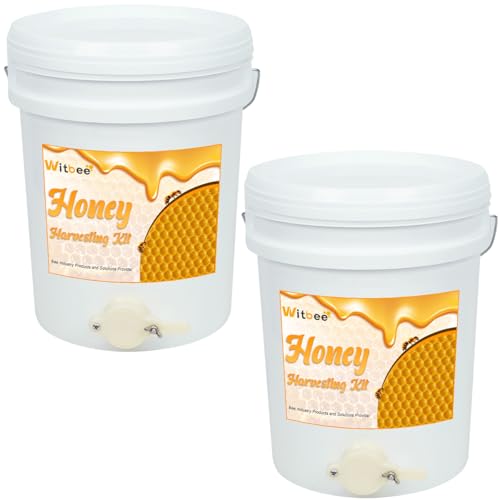
witbee 5-Gallon Honey Buckets with Gate (2-Pack)
Two gated 5-gallon buckets: receiving, settling, bottling, and storage capacity in one order.
Field check: Two 5-gallon buckets · leak-proof gates (listed) · food-grade
You need two buckets, and here is why. A single-bucket harvest constantly interrupts itself: the bucket under the extractor fills, and everything stops while you strain, settle, and bottle before spinning can resume. The witbee 2-pack of gated buckets turns harvest into a pipeline: bucket one catches the extractor's output through your strainer while bucket two, yesterday's honey, settles and bottles. Swap when full. A 5-gallon bucket holds roughly 60 pounds of honey, which is an entire strong hive's annual surplus in one container, so the pair covers most backyard apiaries with room to spare.
The pairing logic with the rest of the line: add your own strainer across the mouth (or the GAIACOLMEIA set above if you want it included), and confirm the honey passed its moisture check before it goes into long storage, honey below the ripeness line keeps essentially indefinitely in a lidded bucket, while wet honey ferments just as happily in a bucket as a jar. As pure capacity per dollar, nothing else in the guide touches this two-pack.
- Station
- Receive, settle, bottle, store
- Capacity
- Two 5-gallon buckets (~60 lbs honey each)
- Outlet
- Leak-proof honey gates (listed)
- Material
- Food-grade plastic (listed)
- Price
- $59.99
What we like
- Two buckets make harvest a pipeline, not a relay
- Roughly 120 lbs of total gated capacity
- Doubles as long-term crop storage
- Best capacity per dollar in the guide
Worth noting
- Strainer not included
- A full bucket is a 60-pound lift
- Plastic wears faster than stainless
Who should buy it: Buy the witbee pair if you already have a strainer solution and want maximum gated capacity: two receiving/settling/bottling/storage vessels for $59.99. The right bucket order for 2 to 8 hive harvests.
What we don't like: No strainer included, this is capacity, not a complete station. Food-grade plastic carries the usual long-term scratch caveat. And a full 5-gallon bucket weighs about 60 pounds; plan your lifting, or bottle from a bench rather than the floor.
Bottom line: Buckets are the freight cars of harvest day, and two is the number that makes the line flow: one under the extractor receiving, one settling or bottling. The witbee 2-pack delivers exactly that, a pair of 5-gallon food-grade buckets with listed leak-proof gates, for $59.99. Roughly 60 pounds of honey capacity each, and between harvests they store the crop itself.
08 · Best Gate Upgrade

BeeCastle Honey Gate Valves (2-Pack)
Turn any food-grade bucket into a bottler: two gate valves for $8.45.
Field check: 2 gate valves for 5-gallon buckets (listed) · $8.45
A honey bucket is just a bucket wearing an $8 valve. The BeeCastle honey gate 2-pack makes that explicit: each valve installs into a hole cut low in the sidewall of any standard 5-gallon food-grade bucket, gasket inside and out, nut snugged, and you have built the bottling vessel the catalogs sell at a healthy markup. Two gates means two buckets, receiving and bottling, for less than nine dollars plus whatever your local hardware store charges for food-grade pails.
Beyond DIY buckets, spare gates earn their keep as insurance: gates are the one moving part in the bottling line, and a cracked or stripped gate mid-harvest, with sixty pounds of honey behind it, is a genuine emergency. At this price, a spare in the harvest box is the cheapest peace of mind in the hobby, right up there with a backup hive tool. If you bought pre-gated buckets above, add this pack anyway; future-you, standing in a sticky kitchen at 9pm, says thanks.
- Station
- Bottling (DIY and spares)
- Contents
- 2 gate valves (listed)
- Fits
- Standard 5-gallon buckets (listed)
- Install
- Drill/cut hole, gasket both sides
- Price
- $8.45
What we like
- Converts any food-grade bucket into a bottler
- Two gates for under nine dollars
- The essential mid-harvest spare part
- Unlimited capacity for hardware-store money
Worth noting
- Leak-free depends entirely on your install
- Plastic valve wears over seasons
Who should buy it: Buy the gate pack if you are the DIY type with access to cheap food-grade buckets, or as the spare-parts insurance every bottling line should carry. The cheapest way to add bottling capacity, period.
What we don't like: Installation is on you: cutting a clean hole and seating gaskets properly takes care, and a sloppy install leaks. Plastic valves also wear where they slide; inspect seasonally. It is an $8.45 part doing a critical job, treat the install with respect.
Bottom line: The cheapest infrastructure in honey handling: the BeeCastle 2-pack converts ordinary food-grade buckets you already own into gated bottling vessels. Drill a hole, seat the gate, and a $5 hardware-store bucket does the job of a $30 honey bucket. At $8.45 for two, this is the tinkerer's route to unlimited bottling capacity.
09 · Best Refractometer
Don't Skip This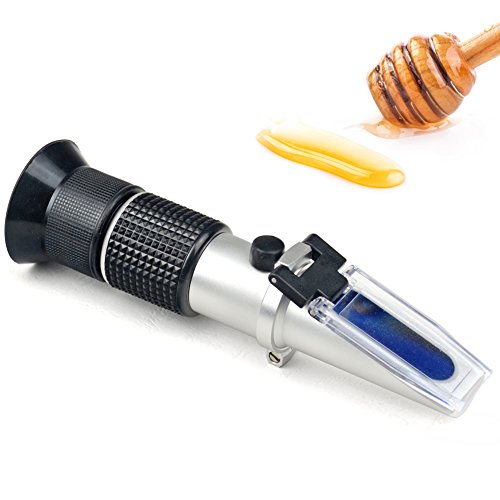
aichose Honey Refractometer
The $23 instrument that decides whether your honey keeps for years or ferments by spring.
Field check: Optical refractometer · honey moisture, Brix, and Baume scales (listed) · $22.88
Capped frames are a good sign; a refractometer is proof. The traditional rule says harvest frames that are mostly wax-capped, because bees cap honey when they have dried it to ripeness. It is a decent rule that fails at the margins, humid climates, part-capped frames, honey that absorbed moisture sitting in the kitchen, and the failure mode is a batch of fermented jars months later. The aichose honey refractometer replaces the guess: smear a drop on the prism, close the plate, aim at light, and read the moisture line on the honey scale. Under 18.6%, bottle with confidence; over it, the honey needs drying time in a dehumidified room before it is safe to jar. The threshold and the fermentation biology behind it are laid out in the standard references, summarized well by the extension Bee Health program.
It earns its keep beyond harvest day too: checking moisture on a mid-season frame tells you whether an early pull is safe, and checking bucket honey before long storage prevents the saddest discovery in beekeeping, a fermented winter's worth of crop. How a refractometer actually works is a pleasant optics rabbit hole; what matters at the bench is that $22.88 permanently removes the biggest quality risk in home honey production. Every reader of our yield explainer gets the same advice: buy this before you buy jars.
- Station
- Verify (moisture)
- Type
- Optical refractometer
- Scales
- Honey moisture, Brix, Baume (listed)
- Key threshold
- Ripe below ~18.6% moisture
- Calibration
- Manual, solution included (listed)
- Price
- $22.88
What we like
- Settles the ferment-or-keep question for $22.88
- Ten-second reading from one drop of honey
- Also guards stored bucket honey
- No batteries, nothing to die mid-season
Worth noting
- Needs initial calibration and decent light
- Scale-squinting is fiddlier than a digital readout
- Wants room-temperature samples
Who should buy it: Buy the aichose with your extractor, before your first harvest: anyone bottling honey needs a moisture answer, and this is the cheapest reliable one. If you harvest honey at all, this is not optional equipment in our book.
What we don't like: It requires a one-time calibration and a light source, and squinting at an internal scale is mildly fiddly compared to the digital reader below. Readings drift with extreme temperatures, let samples reach room temperature. Minor quibbles against a mandatory $23 instrument.
Bottom line: This is the most important cheap tool in the guide. Honey below roughly 18.6% moisture is shelf-stable essentially forever; above that line, wild yeasts can ferment it in the jar. The aichose refractometer answers the question with one drop of honey and ten seconds of daylight, for $22.88. We consider it mandatory equipment, not an accessory.
10 · Best Digital Reader

LAFMATE Digital Brix Refractometer
The push-button moisture answer: digital readout, listed ±0.2% accuracy, no squinting.
Field check: Digital refractometer · 0-95% Brix, ±0.2% accuracy (listed) · LCD readout
Digital buys you repeatability. Two people squinting through an optical refractometer can read the same sample half a point apart; two people pressing the LAFMATE digital refractometer's button get the same number on the same screen. For harvest decisions that hinge on tenths of a percent near the 18.6% ripeness line, that consistency is genuinely useful, and the listed ±0.2% accuracy brackets the decision comfortably. Sampling is identical to the optical: a drop on the prism well, a button press, a wipe with a soft cloth between samples.
Who upgrades? Beekeepers testing constantly through harvest week, anyone drying a wet batch down and checking daily progress, sellers documenting moisture for the farmers-market table, and everyone who has fought an eyepiece in bad light. The battery is the trade: a dead cell on harvest morning is the failure mode optics can never have, so keep a spare taped in the case. Plenty of serious harvest kits carry both instruments, digital for speed, optical as the never-fails backup, and at a combined $63 that redundancy is cheap for the crop it protects on the way to the extractor and the jars beyond.
- Station
- Verify (moisture via Brix)
- Type
- Digital refractometer, LCD
- Range
- 0-95% Brix (listed)
- Accuracy
- ±0.2% (listed)
- Power
- Battery
- Price
- $39.99
What we like
- Push-button readings anyone takes identically
- Listed ±0.2% accuracy brackets the ripeness call
- No eyepiece, no squinting, no ambient-light fights
- Fast enough for daily batch-drying checks
Worth noting
- Battery-dependent: keep a spare
- Brix scale means a conversion step for moisture
- $17 over the optical answer
Who should buy it: Buy the LAFMATE if you test often, share the instrument across family or club members, or want the fastest repeatable readings during harvest week and batch-drying. The right refractometer for people who dislike eyepieces.
What we don't like: It needs a battery, which means it can die at the worst moment; stock a spare. It reads Brix rather than a direct moisture scale, so honey work involves a conversion chart. And it costs $17 more than the optical that answers the same question.
Bottom line: The LAFMATE does the aichose's job with a screen: drop the sample on the prism, press the button, read the number. Listed accuracy of ±0.2%, no eyepiece, no scale-squinting, and results anyone in the family can take identically. At $39.99 it is the convenience upgrade for frequent testers and aging eyes, with a battery dependency as the honest tax.
More gear worth comparing
Beyond this guide: the highest-rated gear across every category and budget, with a live price check on each.




As an Amazon Associate we may earn from qualifying purchases, at no cost to you.
Quick shop: every pick
Skip the scroll: the whole lineup, with a live price check on each.
- Pierce Original Uncapping KnifePremium PickPierce · $209.94Check price →
- Natudeco Electric Uncapping KnifeBest OverallNatudeco · $55.65Check price →
- ROTORS Electric Uncapping KnifeBest Budget Heated KnifeROTORS · $26.99Check price →
- E-outstanding Stainless Uncapping ForkEssential Backup ToolE-outstanding · $8.99Check price →
- Yarra Bee Co Stainless Honey Settling TankBest Settling TankYarra Bee Co · $139.90Check price →
- GAIACOLMEIA Honey Bucket with Gate and Stainless StrainerBest Strainer-Bucket ComboGAIACOLMEIA · $59.99Check price →
- witbee 5-Gallon Honey Buckets with Gate (2-Pack)Best Bottling Bucketswitbee · $59.99Check price →
- BeeCastle Honey Gate Valves (2-Pack)Best Gate UpgradeBeeCastle · $8.45Check price →
- aichose Honey RefractometerBest Refractometeraichose · $22.88Check price →
- LAFMATE Digital Brix RefractometerBest Digital ReaderLAFMATE · $39.99Check price →
How we chose
We rank harvest gear by where it sits in the actual workflow, uncap, spin, strain, settle, verify, bottle, because the right question is never "is this a good knife" but "does this station keep pace with the one before it."
Food contact is a pass/fail gate: anything honey touches must be stainless steel or food-grade plastic, as listed. We flag any listing that is vague about materials.
Heated tools are judged on temperature behavior, does the blade hold a working heat without scorching honey (burnt cappings smell is unmistakable and unfixable), and on cord and handle safety.
Capacity claims and dimensions are the manufacturers' listed figures and are hedged as listed; we do not repeat a spec we cannot verify.
Cheap redundancy beats expensive elegance: a $9 fork that rescues every knife miss outranks a gadget that does one thing beautifully. The line is only as fast as its slowest station.
No placement is paid. Prices come from the verified offer table on the publication date; picks that go dark or spike in price lose their slot on update.
Key terms
- Uncapping
- Removing the thin wax caps bees seal ripe honey cells with, so the extractor can spin the honey out. Done with a heated knife across the comb face, finished with a fork in the low spots.
- Cappings
- The wax removed during uncapping, soaked with honey. Drained over a tray, they yield jar-grade honey and the cleanest beeswax a hive produces; experienced keepers never discard them.
- Settling
- Resting strained honey 24-48 hours in a tank or bucket so air bubbles and fine wax rise into a skimmable surface film. The zero-cost step that makes jars pour clear instead of cloudy.
- Honey gate
- The shut-off valve at the base of a bucket or tank used for controlled bottling: jar under spout, flick open, flick shut. Vastly cleaner than pouring from a 60-pound bucket.
- Refractometer
- The instrument that measures honey moisture (directly, or via the Brix sugar scale) from a single drop. The tool that decides whether honey is safe to bottle or needs drying first.
- 18.6% moisture
- The standard ripeness threshold: honey below roughly 18.6% water resists fermentation and keeps essentially indefinitely; above it, naturally present yeasts can ferment the crop in the jar.
- Brix
- A sugar-concentration scale many refractometers read; ripe honey sits around 81-83 Brix. Converting Brix to moisture percent is a standard chart lookup.
- Food-grade
- Materials rated for food contact, stainless steel or food-safe plastics. Non-negotiable for every surface honey touches, because honey is mildly acidic and stays in contact for hours to months.
Questions, answered
What equipment do I need to harvest honey?
Six stations: an uncapping knife (heated, ideally) and fork to open the cells, an extractor to spin the honey out, a strainer to catch wax, a bucket or tank to settle in, a refractometer to verify moisture, and a gated bucket to bottle from. The extractor is the big purchase; the entire rest of the line costs roughly $150 done sensibly, and this guide ranks each piece.
Do I really need a heated uncapping knife?
Need, no; want within five frames, yes. A cold knife drags and tears through wax cappings, while a heated blade melts through in one smooth stroke, and the difference compounds over a forty-frame harvest. At $26.99 for the budget ROTORS the upgrade is cheap enough that we recommend heat to everyone past their very first harvest, with the $55.65 Natudeco as the sweet spot.
What moisture content should honey be before bottling?
Below roughly 18.6% water. At or under that threshold honey resists fermentation and keeps essentially indefinitely; above it, wild yeasts can ferment it in the jar within months. A $23 refractometer measures it from a single drop in ten seconds, which is why we treat one as mandatory harvest equipment rather than an accessory.
What happens if my honey moisture is too high?
Do not bottle it. Rest the honey in open buckets in a small room with a dehumidifier running, stir daily to expose fresh surface, and re-test with your refractometer; honey sheds moisture steadily in dry air, often a point or more over several days. Once it reads at or below the ripeness line, bottle normally. Bottling wet honey and hoping is how batches ferment.
How do you strain honey after extracting?
Run it through a mesh strainer straight from the extractor gate into a bucket, ideally the same day it is spun, while it is warm and flows fast. Coarse-then-fine mesh catches wax bits and debris while letting pollen through, which is what you want: strained honey keeps its local character, and ultra-filtering removes exactly what makes backyard honey worth producing.
Why is my honey cloudy or full of bubbles?
It was bottled straight from the extractor. Spinning whips honey full of microbubbles and suspends wax fines too small for mesh, and jarred immediately they set as haze and a foam ring. The fix is settling: rest strained honey 24 to 48 hours in a covered bucket or settling tank, skim the film that rises, then bottle from the gate. Same honey, dramatically better jars.
What do I do with the wax cappings after uncapping?
Keep them, always. Let cappings drain over a tray for a day, the honey that drips out is jar-grade, then rinse and melt the wax. Cappings wax is the cleanest beeswax a hive produces, ideal for candles, wraps, and coating next season's foundation. A few hives' worth of cappings melts into a genuinely valuable brick of wax.
Is an optical or digital refractometer better for honey?
Both work; they trade differently. The optical aichose ($22.88) reads honey moisture directly on a labeled scale, never needs a battery, and just requires calibration and decent light. The digital LAFMATE ($39.99) gives push-button readings with listed ±0.2% accuracy that different users take identically, but reads Brix (one conversion step) and dies if the battery does. Frequent testers like digital; everyone should own at least the optical.
Can I harvest honey without an extractor?
Yes: crush-and-strain, cutting the comb out, crushing it, and straining the honey through mesh, needs no extractor and works fine for a first small harvest. The cost is the drawn comb, which is destroyed and must be rebuilt by the bees at real expense to next year's crop. Most keepers graduate to a spinner within a season or two; our extractor guide covers the options from $107.99 up.
How much honey will I actually get to harvest?
First-year colonies usually produce little to no surplus, they are building comb and winter stores. An established, healthy colony in most US regions yields roughly 30 to 60 pounds of surplus in a normal season, with wide swings by forage and weather. We break down the full expectation math, including how much to leave the bees, in our honey-per-hive explainer.
Filed under Buyer's Guide
Part of Honey Harvest
Keep reading
The Best Honey Extractors (2026)
The centerpiece of the line this guide feeds: nine spinners, manual and electric, sized by hive count from $108 to the 8-frame VIVO.
How Much Honey Does One Hive Produce?
Realistic yield expectations before you buy the gear: pounds per hive by region, year, and colony strength, and what to leave for winter.
The Best Beehive Frames and Foundation
The frames you will be uncapping: deep vs medium, foundation choices, and the comb-rotation schedule that keeps harvests clean.
First-Year Beekeeping Calendar
Where harvest actually falls in the season, and everything the colony needs from you before and after it.
The Best Gifts for Beekeepers
Including the Pierce knife, the single most coveted give-them-what-they-will-not-buy-themselves item in the hobby.
Beekeeping Cost Index
The whole hobby priced honestly, harvest line included.